
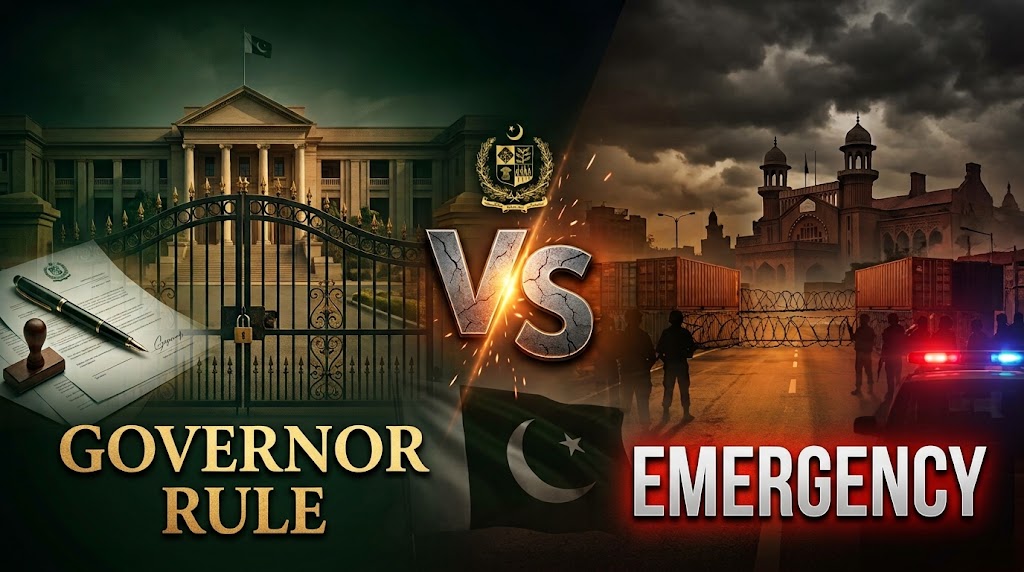
On October 11, 2026, Khyber Pakhtunkhwa saw something that confused a lot of people: Governor's Rule and Emergency were imposed on the same day. If you've been wondering whether these are just two names for the same thing, they're not. This guide explains exactly what each one means, how they differ, and uses the recent KP situation as a real, easy-to-follow example.
The quick answer
In simple terms: Governor's Rule (under Article 234 of Pakistan's constitution) is about who runs a province's government. It shifts a province's administrative powers away from the elected chief minister and cabinet to the Governor, acting on behalf of the federal government. Emergency (under Article 232) is about how serious the security or law-and-order situation is. It's usually declared when a province, a few districts, or even the whole country faces a threat too big for the normal government to handle. These come from different parts of the constitution, and one doesn't require the other, but as Khyber Pakhtunkhwa showed, both can be imposed together.
What is Governor's Rule (Article 234)?
Article 234 comes into play when the President, based on a report from the Governor, becomes satisfied that a provincial government can't be run according to the constitution. When this happens, the President takes over the province's administrative powers, which are then exercised through the Governor. The chief minister and the cabinet lose their administrative authority, and the provincial assembly's powers can be exercised by parliament instead.
At its core, this is a response to a political or administrative breakdown, situations where a provincial government simply can't function or meet its constitutional responsibilities.
What is Emergency (Article 232)?
Article 232 deals with war, external aggression, or internal disturbance serious enough that a provincial government cannot control it. Since Pakistan's 18th Amendment, declaring an emergency over "internal disturbance" (as opposed to war) requires a resolution from the relevant provincial assembly first. During an emergency, the federal government gains additional powers, and it can be applied to the whole country, an entire province, or just specific districts.
This is fundamentally a security-driven measure, used for terrorism, insurgency, or unrest that regular administration can't contain on its own.
The key differences at a glance
| Aspect | Governor's Rule (Article 234) | Emergency (Article 232) |
|---|---|---|
| Core trigger | Provincial government unable to function constitutionally | War, external threat, or serious internal unrest |
| What it affects | The chief minister and cabinet's powers | Civil liberties and federal government powers more broadly |
| Scope | An entire province | The whole country, a whole province, or specific districts |
| Precondition | President satisfied based on Governor's report | Provincial assembly resolution (for internal disturbance) |
| Maximum duration | Six months (with parliamentary approval) | No fixed maximum, but requires periodic parliamentary approval |
| Who declares it | The President, on the Prime Minister's advice | The President, on the federal cabinet's recommendation |
Can both be imposed at the same time?
Yes, and that's exactly what happened. On October 11, 2026, Governor's Rule was imposed across the whole of Khyber Pakhtunkhwa, suspending Chief Minister Sohail Afridi's government. At the same time, a separate Emergency was declared specifically in 12 districts, eight newly merged tribal districts plus four southern districts, where the security situation was considered most severe. Reports describe this as the first time in Pakistan's history that both measures were applied together.
This example makes the difference easy to see: Governor's Rule suspended the entire provincial government, while Emergency created additional security powers and a special administrative structure (called an Area Development Secretariat) only in those 12 specific districts. The rest of the province remained under Governor's Rule alone, without Emergency being declared there.
How is this different from martial law?
A third term often adds to the confusion here: martial law. Both Governor's Rule and Emergency operate within the constitution, with defined conditions and time limits. Martial law is entirely different, it means the military takes direct control, and the constitution itself is typically suspended. Pakistan's constitution doesn't even outline a procedure for martial law. In the 2026 example, both measures, Governor's Rule and Emergency, were carried out through a constitutional process by a democratically elected federal government, not through martial law.
Past examples in Pakistan
- 1949, Punjab: The first-ever Governor's Rule, with no Emergency involved
- 1998, Sindh: Emergency declared, with powers handed to the Governor
- 2009, Punjab: Governor's Rule alone, following a court ruling
- 2013, Balochistan: Emergency alone, after attacks on the Hazara community
- 2026, Khyber Pakhtunkhwa: Both together, for the first time
Frequently asked questions
Are Governor's Rule and Emergency the same thing?
No. Governor's Rule is about who controls a province's government. Emergency is about how serious a security or law-and-order crisis is. They come from separate articles of the constitution.
Can Emergency be declared in just a few districts?
Yes. Emergency can apply to the whole country, an entire province, or only specific districts, as seen with the 12 districts in Khyber Pakhtunkhwa in 2026.
Can Governor's Rule apply to the whole country?
No. Governor's Rule under Article 234 always applies to a single province's government. It isn't a nationwide measure.
Which one is more severe?
Both are serious, but Emergency typically grants broader and more extraordinary powers, especially security-related ones, while Governor's Rule is more specifically about transferring administrative and political authority.
Do they last the same length of time?
Governor's Rule is constitutionally capped at six months, with parliamentary approval required along the way. Emergency has no fixed maximum duration, but it also requires periodic parliamentary approval to continue.
Here's a simple way to remember it: Governor's Rule answers the question "who's in charge of the government?" while Emergency answers the question "how serious is the situation on the ground?" They come from different triggers, and as Khyber Pakhtunkhwa's 2026 example shows, they can be declared together when circumstances call for both.