
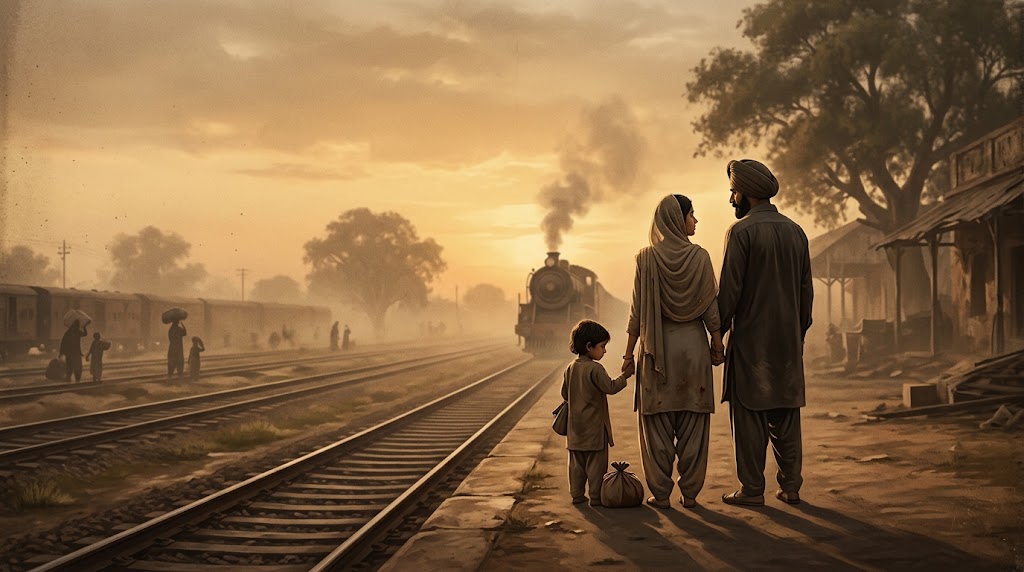
1947: A line was drawn, and one country became two. Families were torn apart, and millions of people became strangers in their own homes. Hatred hung over the entire subcontinent, yet in that blood-soaked era, a love story was born, one that people still remember with heavy hearts, decades later. It is the story of Boota Singh and Zainab.
Who was Boota Singh?
Boota Singh was a Sikh soldier from the city of Jalandhar in Indian Punjab. He had fought on the Burma front in the Second World War, serving under the British government. When the war ended, he returned to his village and settled into a quiet life. But the peace did not last. Before long, the violence of Partition swept through every village in Punjab. Fire, terror and fear were everywhere.
Zainab arrives
In the middle of that chaos, a young Muslim girl named Zainab became separated from her family while migrating. Running for her life and wandering from place to place, she finally reached Boota Singh's doorstep. He became her protector and gave her shelter in his home.
But the villagers could not accept it. At a time when trains full of corpses were arriving, how could they tolerate a Muslim girl living safely in their village? People began to speak against Boota Singh.
From necessity to love
To silence the taunts, Boota Singh and Zainab married out of necessity. At first it was only a temporary arrangement, but as time passed, that necessity slowly turned into love. Both embraced their new life wholeheartedly. They had a daughter, whom they named Tanveer.
An agreement, and a separation
Around that time, Pakistan and India reached an agreement under which women abducted during the riots were to be traced and returned to their families. Zainab fell under this agreement. The Indian police found her, and despite Boota Singh's pleas and their legal marriage, Zainab was forcibly sent to Pakistan, to her family.
The journey to Lahore
Boota Singh could not bear the separation from his wife. Taking his daughter Tanveer with him, he traveled from Jalandhar to Lahore. They say that if you search hard enough, you can even find God, and this was Zainab. He reached her village, Narpur, but her family flatly refused to accept him.
Boota Singh did not give up. He converted to Islam and took the name Jamil, hoping that Zainab's family might finally accept him. Instead, they arranged Zainab's marriage elsewhere.
The doors of the court, and a broken heart
As a last hope, Boota Singh knocked on the doors of a Pakistani court, wondering if he might find justice there. But in court, under pressure from her family, Zainab refused to go with Boota Singh to India and even denied that he was her husband.
The woman for whom Boota Singh had left his homeland, given up his identity and even changed his faith now refused to recognize him. That coldness broke him from within.
The final journey
In utter despair, Boota Singh jumped in front of an oncoming train near Shahdara railway station, holding his daughter Tanveer. Boota Singh died on the spot, while his daughter miraculously survived.
The will, and a final resting place
A will was found on Boota Singh, asking that he be buried in the graveyard of Zainab's village, Narpur. But Zainab's family did not allow it. In the end, his journey of love and sorrow came to a close at Miani Sahib graveyard in Lahore, where he was laid to rest with his unfinished love and his despair.
A story that lived on
Inspired by this incident, novels were written, and films such as "Shaheed-e-Mohabbat", "Veer-Zaara" and "Gadar", along with dramas like "Dastaan", were made. To this day, people remember Boota Singh as the "martyr of love".
The story of Boota Singh and Zainab is not just the story of two people. It is a picture of an era when a line on a map cut through the bonds between hearts. It reminds us that the wounds of Partition were not inflicted only on land. They were inflicted on human hearts too, and some of them are still fresh today.
Written by Faizan Ak Azaad