
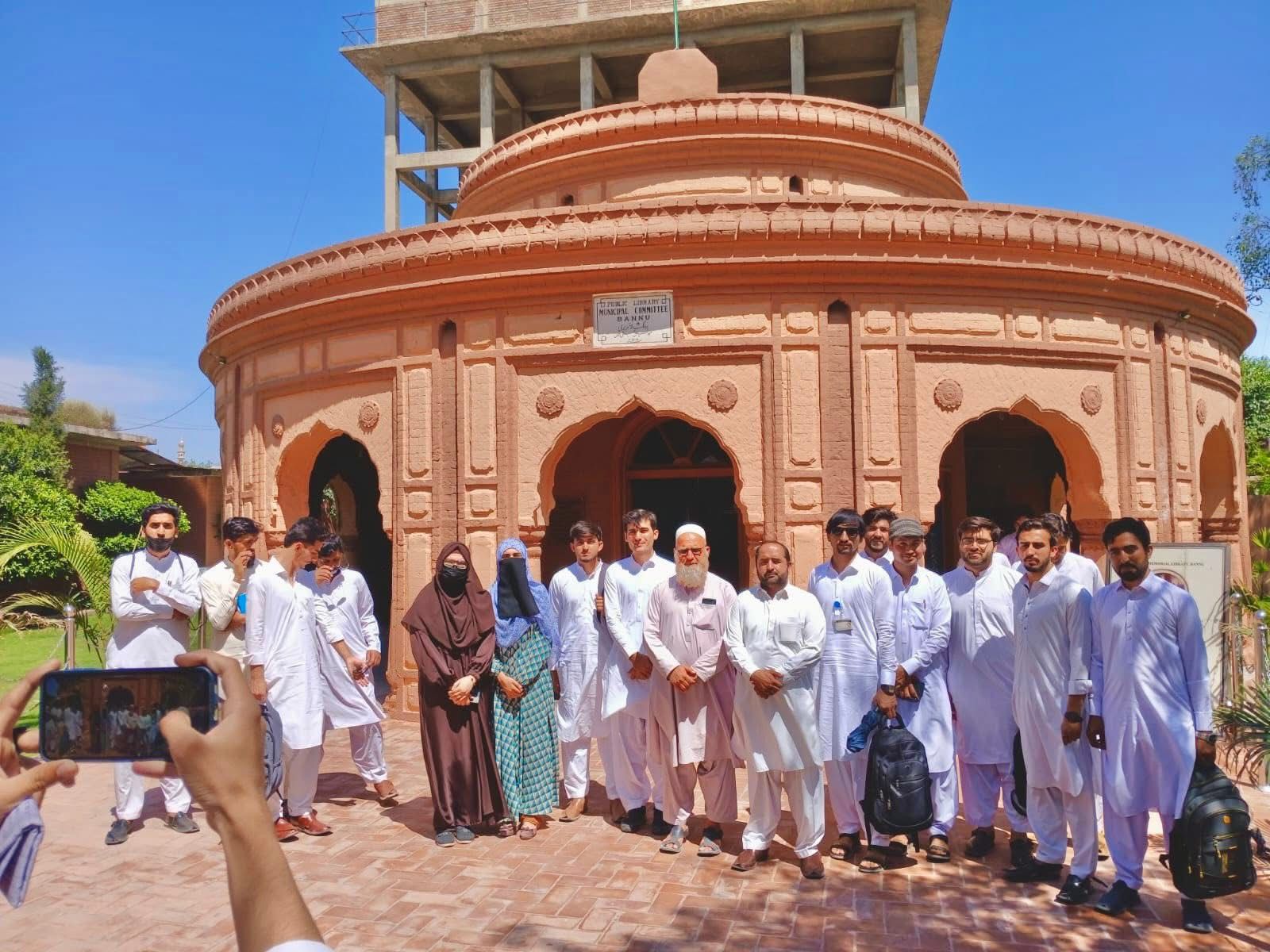
Few cities can claim three names in fifty-five years. Bannu was founded as Dhulipnagar in 1848, became Edwardesabad in 1869, and got its present name in 1903. Behind those changes sits a much older story, one that starts with village potters and bead makers thousands of years ago and runs through tribal migration, empires, colonial ambitions and modern Pakistan.
This guide walks through the history of Bannu in order: the prehistoric sites, the origin of the name, the arrival of the Bannuchi tribes, the British era, and the city as it is today. Where historians disagree, I've said so instead of picking a side.
In this guide
- Bannu at a glance
- A timeline of Bannu's history
- Ancient Bannu: Lewan, Sheri Khan Tarakai and Akra
- Where does the name Bannu come from?
- The medieval period and the Bannuchi migration
- The legend of the three pigeons
- Edwardes and the British era
- Bannu after 1947
- Lewan today: heritage that needs attention
- Places to see for history lovers
- Frequently asked questions
Bannu at a glance
| Item | Detail |
|---|---|
| Location | Southern Khyber Pakhtunkhwa, near the Kurram River; capital of Bannu Division |
| Landscape | A circular alluvial plain surrounded by low hills, drained by the Kurram and the Tochi (Gambila) |
| Founded as a town | 1848, by Lieutenant Herbert Edwardes |
| Names over time | Dhulipnagar (1848), Edwardesabad (1869), Bannu (1903) |
| Main local tribe | Bannuchi (also spelled Banuchi, Bannuzai) |
| Known for | Bannu pulao and painda, fertile farmland, its role as a gateway to Waziristan |
A timeline of Bannu's history
| Period | Event |
|---|---|
| Around 3rd millennium BCE | Settlements such as Lewan flourish in the Bannu basin |
| Around 300 BCE | Finds from the Akra mounds date from about this time, according to Britannica |
| 11th century CE | The Ghaznavid expansion reaches the region |
| 13th to 15th century | Bannuchi tribes settle in the valley (accounts vary) |
| 1505 | Babur passes through the region |
| Mid-18th century | Bannu comes under the Durrani Empire |
| 1847 to 1848 | Edwardes arrives, Dhulipgarh fort is begun, and the town is founded |
| 1849 | The British annex Punjab, including Bannu, after the Second Anglo-Sikh War |
| 1869 | The town is renamed Edwardesabad |
| 1903 | It receives its present name, Bannu |
| 1947 | Bannu becomes part of Pakistan |
| 1962 | The Kurram Garhi Project is completed |
| 2005 | The University of Science and Technology, Bannu is established |
Ancient Bannu: Lewan, Sheri Khan Tarakai and Akra
Bannu's story begins long before any written record. Archaeologists working in the Bannu basin have found some of the region's oldest village settlements, and the valley clearly mattered as a route between the Indus plains and the highlands to the west.
Sheri Khan Tarakai
Excavations at Sheri Khan Tarakai in the 1980s identified it as the oldest known village settlement in the Bannu region. It belongs to a Neolithic phase that archaeologists now call the Sheri Khan Tarakai phase. Later cultures built on that foundation.
Lewan
Lewan is the site that deserves to be far better known. It has two layers of occupation, from the Tochi-Gomal phase and the later Kot Diji phase, and both fall roughly in the third millennium BCE, so around 4,500 to 5,000 years ago. Excavations there turned up evidence of bead-making and pottery production, and the Kot Diji layer included an intact pottery kiln.
The site was first studied by the Cambridge-Peshawar Universities expedition of 1977 to 1978, led by the archaeologist F. R. Allchin, and it was explored again by the Bannu Archaeological Project between 1995 and 2001. What it shows is a community that was making and trading goods, not just farming.
Akra
The Akra mounds near Bannu are another important site. Britannica dates finds from Akra to about 300 BCE. Some accounts suggest occupation at Akra began much earlier, so it's best to treat the exact starting date as an open question until you see it in a published excavation report.
Where does the name Bannu come from?
Nobody agrees on a single origin. The Chinese pilgrim Xuanzang visited this part of the world in the 7th century, and the Khyber Pakhtunkhwa government's district profile says he paused in a city he called "Banna" in 645 CE. Not every historian is convinced that his "Banna" is the same place as modern Bannu, so this remains a debated link.
Another suggestion, from the philologist Michael Witzel, connects the name to the Avestan word Varəna. Locals also know the city by its Pashto name, Bani. Spellings in old British records vary too, from Bunnoo to Bannu.
The medieval period and the Bannuchi migration
In the early 11th century, the Ghaznavids expanded into South Asia, and the Bannu valley came under their wider influence. Like most of the frontier, it kept its own local structure while empires rose and fell around it.
The event that shaped Bannu's identity most was the arrival of the Bannuchis. According to the account written by the British administrator S. S. Thorburn in Bannu, or Our Afghan Frontier, the Hani and Mangal tribes were living in the valley when the descendants of Shah Farid, known as Shitak, were living in the Shawal highlands. Shawal lies between today's Afghan province of Paktika and North Waziristan.
Those descendants became known as the Bannuchis or Bannuzai. Two things pushed them toward Bannu. The Wazir tribes were advancing toward Shawal and making life there unsafe, and, according to Thorburn's account, a local elder called Pir Roshan invited them to take the fertile land between the two rivers after the Hani and Mangal had insulted him.
When did this happen? Accounts differ. Thorburn's estimate puts the Bannuchis on the banks of the Tochi at the end of the 13th century, while other accounts place their settlement in the 14th and 15th centuries. It's likely that the settlement was gradual rather than a single event.
Babur and the Durranis
In 1505, the first Mughal emperor, Babur, marched through the region. In the Baburnama, he describes the valley's fertility and the resistance of the local tribes. By the middle of the 18th century, Bannu was part of the Durrani Empire under Ahmad Shah Abdali. It supplied revenue and soldiers, although the tribes kept a high degree of internal autonomy.
The legend of the three pigeons
Today, a dispute over a few marlas of land can drag on for years of jirgas. There's a story in Bannu's past where an entire valley changed hands without a battle. Thorburn recorded it, and it's told to this day.
According to the story, the Hani and Mangal chiefs heard that the newcomers had reached the Tochi and were about to attack. They remembered that they had insulted Pir Roshan, and hurried to ask him what they should do.
The Pir set three pigeons in front of them. The first was unharmed. The second had its feathers plucked. The third had lost its feathers and feet. Then he explained the message. If they left before the newcomers arrived, they would stay safe like the first pigeon. If they stayed, they would be hurt like the second. And if they refused to let the newcomers settle, they would be destroyed like the third.
Frightened, the chiefs offered little resistance. Another account says it was less peaceful, and that the Shitakzai defeated the Hani and Mangal and pushed them toward the hills of Kohat and Kurram. Whichever version you prefer, the outcome was the same. The descendants of Shitak settled here, divided the land among themselves, and became the people we know today as Bannuchis.
Later, the Bannuchis themselves divided into two major factions, the Tor Gund and the Speen Gund, who competed for decades. That is a story for another post.
Edwardes and the British era
Before Edwardes
By the 1840s, the valley was under the authority of the Sikh state in Lahore, and the main issue was unpaid revenue. After the First Anglo-Sikh War, the British Resident, Henry Lawrence, sent a young officer, Lieutenant Herbert Edwardes, with a Sikh force to settle the outstanding revenue. Before then, the valley had consisted of many scattered, fortified villages known as kots.
The fort and the new town
Edwardes chose a site and Sikh regiments began building the fort on 18 December 1847. He named it Dhulipgarh after the young Maharaja Duleep Singh. The town beside it was founded in 1848 as Dhulipnagar, and it was planned around the fort and its bazaar. The fort later became the heart of the Bannu Cantonment.
After the Second Anglo-Sikh War in 1849, the British annexed Punjab, including Bannu. Bannu became a frontier district, and it was used as a base for expeditions into Waziristan.
Three names
Edwardes died in 1868, and the town was renamed Edwardesabad in his memory in 1869. In 1903, it was renamed Bannu. The name we use today is the oldest of the three, since it goes back to the valley itself.
The walled city and its gates
The old city was enclosed by a wall with gates. Sources disagree on the exact number, with some saying nine and others ten. Several gates, including Hinjal, Miryan and Mandan, carry the names of Bannuchi clans. Lakki Gate is another name many people still use.
The wall itself is gone. It was taken down in the name of beautification, but the gate names remain in daily use as neighbourhood landmarks.
Schools, a hospital and a railway
The British era also left institutions. In the late 19th century, Dr. Theodore Pennell established a mission hospital and school in Bannu, and Pennell High School became one of the frontier's best-known schools. A narrow-gauge railway line linked Bannu with the Indus at Kalabagh (Mari Indus), mainly to move troops and supplies.
The cantonment was laid out with wide roads and colonial bungalows. It looked very different from the dense, older streets of the city.
Bannu after 1947
When Pakistan was created in 1947, Bannu became part of the North-West Frontier Province, now Khyber Pakhtunkhwa. It shifted from a garrison town to a centre of trade, education and daily civic life for the southern districts.
Farming and roads
Water shaped the modern city. The Kurram Garhi Project, completed in 1962, provides irrigation, power and flood control, and it helped strengthen the farming economy. Wheat, maize and barley are the main crops. Roads linking the Indus with Peshawar and Waziristan confirmed Bannu's position as a trade junction and a gateway to Waziristan.
Education
Education has become one of Bannu's strengths. The University of Science and Technology, Bannu was established in 2005, and the city also has medical education. Government Postgraduate College Bannu dates its founding to 1951 and has produced generations of teachers, officers and professionals.
Food and hospitality
Bannu is known across Pakistan for Bannu pulao and painda. Hospitality is central to Pashtun tradition, and visitors often mention it first.
Resilience
Bannu has lived through difficult years. During the conflict in the tribal areas, it hosted large numbers of families displaced from neighbouring regions, notably around 2014. That role as a refuge is part of the city's modern story.
Lewan today: heritage that needs attention
Lewan is one of the most important prehistoric sites in the Bannu basin, and it is little known to the public. As far as we know, there's no visitor centre, signage or public archaeological park there. Most of what researchers have learned has appeared in academic journals, which local students and families rarely see.
That is an opportunity. Schools, local historians and heritage groups could do a lot by documenting the site, sharing what is known and pushing for proper protection. If you know of any recent developments at Lewan, please tell us so we can update this section.
Places to see for history lovers
- The Bannu Fort area (Dhulipgarh): the original heart of the town, now part of the cantonment. Check access rules before you go.
- The old city and its gate neighbourhoods: Lakki, Mandan, Miryan and Hinjal are worth walking through for the bazaars alone.
- Bannu Museum: check current opening hours before visiting.
- Pennell Memorial Hospital and school area: a reminder of the mission-era institutions.
Frequently asked questions
Who founded Bannu?
Lieutenant Herbert Edwardes founded the town in 1848. The valley itself had been inhabited for thousands of years, and the Bannuchi tribes settled in it in the medieval period.
What was Bannu called before?
The town was founded as Dhulipnagar, renamed Edwardesabad in 1869, and given the name Bannu in 1903.
Who are the Bannuchis?
The Bannuchis, also written Banuchi or Bannuzai, are the main tribe of the Bannu valley. According to Thorburn's account, they descend from Shah Farid, known as Shitak, and came to Bannu from the Shawal highlands.
When did the Bannuchis settle in Bannu?
Accounts differ. Some place it at the end of the 13th century, others between the 14th and 15th centuries. It was probably a gradual process.
What is Lewan?
Lewan is a prehistoric settlement near Bannu with occupation layers from the Tochi-Gomal and Kot Diji phases, roughly 4,500 to 5,000 years ago. Excavations found evidence of bead-making and pottery production.
What is Bannu famous for?
Bannu is famous for its pulao and painda, its fertile farmland, and its role as a gateway to Waziristan. It also has a long history that goes back to prehistoric times.
Final thoughts
Bannu's history doesn't fit into a single chapter. There are prehistoric bead makers, migrating tribes, imperial armies, a colonial fort and a modern university, all in one valley. The more of that story we know, the better we can protect and share it.
Do you have a family story, a photograph or a correction about Bannu's history? Send it to The Opinions. This platform exists for the voices that deserve to be heard.
Sources and further reading:
- Encyclopaedia Britannica: Bannu
- Bannu Cantonment Board: History
- Khyber Pakhtunkhwa government: Bannu district profile
- The News on Sunday: The spirit of Bannu
- Ancient Pakistan: Chronology of the Protohistoric Culture Phases in Bannu and the Gomal Plain
- S. S. Thorburn, Bannu, or Our Afghan Frontier (1876)
- Allchin and others, Lewan and the Bannu Basin (1986)
Note: This article is a general historical overview based on published sources. Dates and details for the early and medieval periods are debated among historians, and we have tried to note where accounts differ. Corrections are welcome. Last updated: September 2026.