
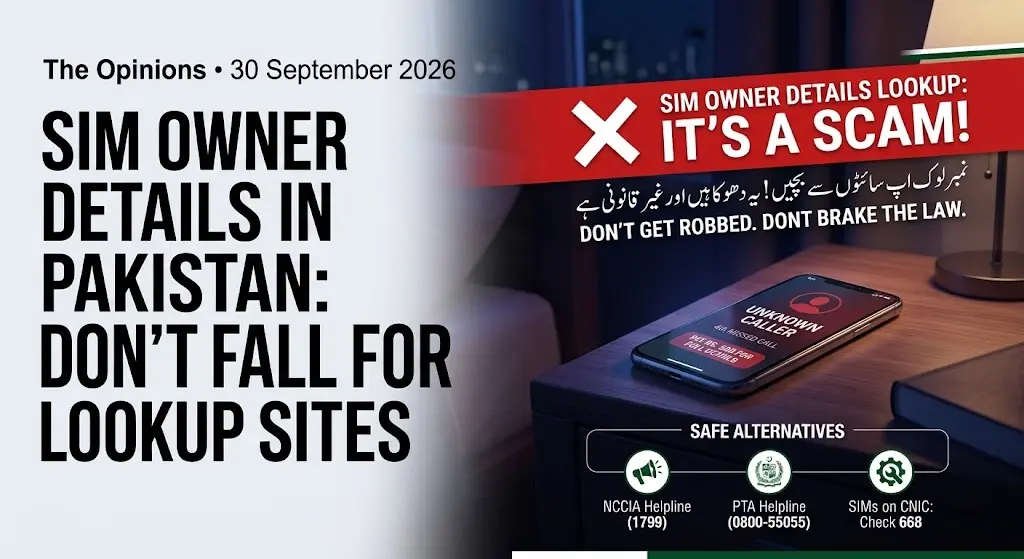
It's 11 at night. An unknown number has called you four times, and the last message was ugly. You open Google and type the first thing that comes to mind: "SIM owner details."
Almost everyone in Pakistan has been in some version of that moment. And that's exactly where a lot of people get robbed. This post is for you if you searched for a number's owner, or if you were about to pay a website to tell you.
Seedhi baat (Urdu mein): Kisi ke number ka naam, CNIC ya address dikhane wali websites zyada tar dhoka hain. Woh "premium" ke naam par paisa mangti hain aur phir kuch nahi dikhati. Aur kisi doosray ka data lena qanooni jurm bhi hai. Agar koi tang kar raha hai, to NCCIA (1799) ya PTA (0800-55055) ko shikayat karein.
Is it legal to check someone's SIM owner details?
No. A person's name, CNIC and address are personal data, and getting hold of them through an unofficial website isn't something the law allows. Under the Prevention of Electronic Crimes Act (PECA) 2016, obtaining, selling, possessing or using someone else's identity information without authorisation is an offence (Section 16 covers this). PECA was amended in 2025, so check the current text or ask a lawyer if you need the exact penalty.
And paying for the data doesn't make it legal. It just means you lost money and did something risky at the same time.
How the "premium version" trick works
Here's a scene you might recognise. You land on a site that says "Enter number, get full details free." You type the number. A loading bar crawls across the screen, and then you see half a result. Maybe a first name, maybe a blurred line.
Then comes the button: unlock full details, Rs. 500, or "upgrade to premium." Some ask you to send money to an Easypaisa or JazzCash number. Others ask you to download an app.
Once you pay, one of three things usually happens. The site gives you random or fake information, it asks for more money, or it disappears. The sites are built to catch people at their worst moment, when you're angry, scared or in a hurry, and you don't stop to think.
There's a second cost people don't notice. To use the site, you typed your own number, and maybe your CNIC, and maybe your payment details. Now that information belongs to whoever runs it.
Why these sites can't be trusted in the first place
SIM registration data sits with the mobile operators and the regulator. There is no public, legal website where a stranger can type a number and see the owner. If a site claims otherwise, it's either making up the results or using data it has no right to hold.
Some sites say they can pull records of SIMs registered before 2018. Even when something shows up, it could be old, wrong, or about a completely different person. Acting on it can get you into an argument with an innocent family. Many such sites have also reportedly been blocked by PTA and NCCIA, which is why they keep popping up under new names.
Loan apps deserve a separate mention. Many Pakistanis go looking for numbers after they get abusive calls from a loan app collecting from their contacts. That's a real crime, and it's the type of case the NCCIA exists to handle. A lookup website won't help you with it.
What to do instead, depending on your problem
| Your problem | What actually works |
|---|---|
| Harassing calls or messages | Screenshot everything, block the number, and complain to the NCCIA (1799 or complaint.nccia.gov.pk). For SIM-related misuse, PTA's helpline is 0800-55055. |
| Blackmail, threats or fake "wrong transfer" calls | Don't pay and don't argue. Keep the messages and transaction proof and report it to the NCCIA. |
| You suspect a SIM was issued on your CNIC without your knowledge | Check the SIMs registered on your CNIC using PTA's 668 SMS service, then contact your operator and PTA about any you don't recognise. |
| Someone owes you money | Use a written notice, the police or a court. Authorities can request records from operators through proper legal channels. |
| You already paid a lookup site | Call your bank, Easypaisa or JazzCash helpline right away, then report it to the NCCIA. |
How to file a complaint with the NCCIA
The National Cyber Crime Investigation Agency took over cybercrime cases from the old FIA cyber wing, so some guides online are outdated. Its official page says you can file through complaint.nccia.gov.pk, email [email protected], or visit a Cybercrime Reporting Centre in person. The helpline is 1799.
Keep your complaint number safe. If you live abroad, you can nominate a relative in Pakistan to follow up on your behalf, according to the NCCIA's guidance. For an operator complaint, call your network's helpline (111 for Jazz, 310 for Zong, 333 for Ufone) and ask for the complaint reference.
If someone is harassing you, do this first
Don't reply, and don't threaten back. Take screenshots of the messages and the call log, and write down the dates and times. Block the number. Then report it.
Tell one person you trust, a brother, a friend, a colleague. Harassment and blackmail get worse when people handle them alone and in silence, especially women and young people who fear what "log kya kahenge."
Already entered your details or paid? Here's what to do
Stop using the site and don't install anything it asked you to. Call your bank or wallet provider and ask them to flag the payment. Check the SIMs on your CNIC through 668. Change the passwords for any account linked to that number and switch on two-step verification. Then report it to the NCCIA.
Quick red flags
Walk away if a site says "free" and then asks for money at the last step, wants an OTP, asks you to install an app, shows only a blurred result, accepts payment to a personal wallet number, or claims to have "live" data on any number in Pakistan. Real government services don't work that way.
Frequently asked questions
Is SIM owner details check legal in Pakistan?
Checking the SIMs registered on your own CNIC through official channels is fine. Looking up a stranger's identity through an unofficial website isn't.
Kisi number ka data kaise pata karein?
There's no legal public way. If the number is harassing you or committing fraud, report it to the NCCIA on 1799. If it's a legal dispute, go through the police or a court.
Are SIM database websites real?
Most are scams, and even the ones that show data are illegal to use. Many have been blocked.
How do I check how many SIMs are on my CNIC?
PTA offers an SMS service on 668 for this. Check PTA's official website for the current instructions before you send your CNIC.
Where can I complain about harassment or fraud?
To the NCCIA on 1799 or at complaint.nccia.gov.pk. For SIM-related issues, you can also call PTA on 0800-55055.
I already paid. Can I get my money back?
Contact your bank or wallet provider immediately and report the fraud to the NCCIA. The sooner you act, the better your chances.
Final thoughts
When someone is scaring you, the urge to find out who they are can feel urgent. But a "lookup" website doesn't solve that. It only adds a scammer to your list of problems.
Keep the evidence, report to the right place, and let the authorities trace the number. It's slower, but it's the only way that protects you and doesn't put you on the wrong side of the law.
Been targeted by a lookup scam, or helped someone who was? Share your story (without personal details) with The Opinions. This platform exists for the voices that deserve to be heard.
Sources and official contacts:
- NCCIA: How to report a complaint (official FAQ)
- NCCIA complaint portal
- Pakistan Telecommunication Authority (PTA): helpline 0800-55055, website pta.gov.pk
- Prevention of Electronic Crimes Act (PECA) 2016, as amended in 2025
Note: This article is for awareness and is not legal advice. Laws, penalties, helpline numbers and procedures change, so confirm current details with the official sources or a qualified lawyer. Last updated: September 2026.