
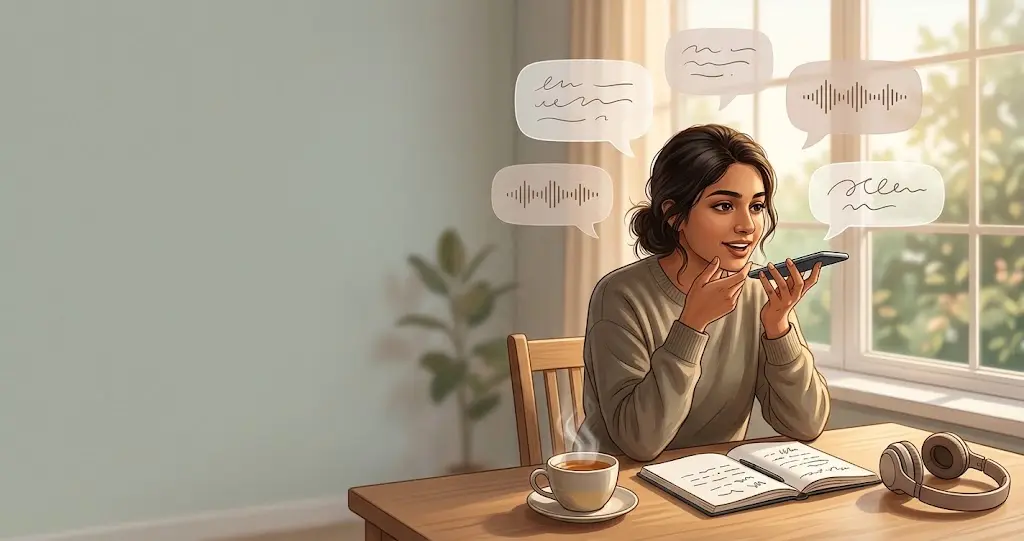
You've studied English for years. You can read a newspaper, follow a movie, even write a decent email. Then someone asks, "So, tell me about yourself," and your mind goes completely blank.
If that sounds familiar, the problem isn't your intelligence. It's that reading and speaking are different skills, and most of us practise only the first one. This guide shows you how to improve your English speaking at home, for free, with a short daily routine, the mistakes Urdu speakers make most often, and a simple 30-day plan.
Why you freeze when you speak
When you read, you get time to think. When you speak, you have to pick words, build a sentence, pronounce it and listen to the other person, all in about two seconds. For many of us there's an extra step too: thinking the sentence in Urdu first, then translating it. That extra step is what causes the pause.
Speaking is closer to cycling than to studying for an exam. You can't learn it by reading about it. Your mouth needs repetition. So the fix is boring but reliable: less studying about English, more saying English out loud.
A daily 15-minute routine that works
Fifteen minutes a day beats two hours once a week. Pick a fixed time, maybe right after Fajr, after dinner, or on your commute if you're on a bus, and split it like this.
Minutes 1 to 5: Shadowing
Play a short English clip (30 to 60 seconds) and repeat it right after the speaker, copying the rhythm and tone, not just the words. Don't aim to understand every word. Aim to sound like them. BBC Learning English's "6 Minute English", VOA Learning English and TED talks with transcripts are all good sources. Repeat the same clip three or four times before moving on.
Minutes 6 to 10: Talk about anything
Speak out loud on a simple topic. Your day, your favourite food, a cricket match, your plan for tomorrow. Use your own life, because you already have the ideas and can put all your energy into finding the English words. If you get stuck, don't stop. Use a simpler word and keep going.
For example, say you're making tea. You might say: "I'm boiling water. I need sugar. Oh, the milk is finished, so I'll have black tea today." It sounds silly. It also trains your brain to build English sentences without translating.
Minutes 11 to 15: Record and listen back
Record one minute of your speaking on your phone and play it back. Listen for long pauses, words you weren't sure about and sounds that didn't come out clearly. Write down one thing to fix tomorrow. Just one. You'll hate the sound of your own voice for the first week, and that gets better.
Mistakes Urdu speakers make (and how to fix them)
Many common errors come from translating directly from Urdu. Here are the ones you'll hear most often.
| What people often say | Better English | Why |
|---|---|---|
| "I have 20 years." | "I'm 20 years old." | English uses "to be" for age, not "to have" |
| "I am agree with you." | "I agree with you." | "Agree" is already a verb |
| "Let's discuss about this." | "Let's discuss this." | "Discuss" doesn't need "about" |
| "My cousin brother." | "My cousin." | "Cousin" already covers male and female |
| "I am having a car." | "I have a car." | Ownership uses simple present |
| "Please prepone the meeting." | "Please move the meeting earlier." | "Prepone" is common in South Asia, but not widely understood elsewhere |
Don't panic if you catch yourself making one of these. Now that you know them, you can fix them one at a time.
The "v" and "w", and "th" problem
Many Urdu and Hindi speakers mix up "v" and "w", so "very" and "wary" can sound alike. The "th" sounds in "think" and "this" also cause trouble. For "v", gently touch your top teeth to your bottom lip. For "w", round your lips without touching your teeth. Practise short pairs like "vest" and "west", or "vine" and "wine", and record yourself to check. You don't need to lose your accent. You just need to be clear.
Learn phrases, not lonely words
Fluent speakers don't build sentences one word at a time. They use ready-made chunks like "to be honest", "it depends on", "I'm looking forward to it" or "I didn't catch that, could you repeat it?". When you learn a new word, learn it inside a whole sentence. Then say that sentence out loud three times. It's a small change, and it makes your speech faster and more natural.
Where to practise for free
- Listening: BBC Learning English, VOA Learning English, English podcasts and YouTube talks. Choose content slightly below your level so you can follow most of it.
- Speaking with people: A friend who is also learning, an English club at your college, or a language-exchange app such as HelloTalk or Tandem. Two short conversations a week are enough to make a difference.
- Practice partners when nobody is free: Voice notes to yourself, Google's voice typing, or an AI chat assistant. Speak your answer, then read what the tool wrote down. If it wrote a wrong word, your pronunciation may need work.
- Reading aloud: Take a news paragraph or a page from a story and read it slowly, then again faster with more expression.
Common mistakes that slow you down
The biggest one is waiting until you feel "ready." That day doesn't arrive, so start now, even if your English is imperfect. The next biggest is studying grammar for months without opening your mouth. Then there's translating every sentence from Urdu, trying to copy a foreign accent instead of aiming for clarity, practising for hours once and then disappearing for weeks, and comparing yourself to fluent speakers rather than to your own past self.
Being understood matters more than being perfect. If the other person got your message, you did fine.
A 30-day English speaking plan
| Week | Focus | What to do daily |
|---|---|---|
| Week 1 | Build the habit | 5 minutes of self-talk, 5 of shadowing, 5 of listening |
| Week 2 | Sound clearer | Record one minute, listen back, fix 3 to 5 tricky words or sounds |
| Week 3 | Talk to people | Two conversations this week, plus daily read-aloud practice |
| Week 4 | Build confidence | Give a two-minute talk on one topic each day |
On day 30, play your first recording and your latest one back to back. Most people are surprised by the difference, and that's usually the best motivation to keep going.
Frequently asked questions
How can I improve my English speaking at home?
Practise out loud every day. Talk to yourself, shadow English audio, read aloud, and record and review your own voice. Add short conversations with a partner as soon as you feel able to.
Can I learn to speak English fluently without a teacher?
Yes, many learners improve a lot through self-study because speaking mostly needs time and repetition. A teacher or partner is still helpful for feedback, so combine both when you can.
How can I stop being afraid of speaking English?
Start in private, by talking to yourself and recording your voice, then move on to a friendly partner. The more you speak, the less scary it feels.
How many hours a day should I practise?
Fifteen to thirty focused minutes is enough for most learners. Short, regular sessions work better than rare long ones.
How long does it take to become fluent?
It depends on where you start and how often you practise. Many learners notice smoother speech within a few weeks of daily practice, while reaching a high level takes months or years of steady work.
Is grammar important for speaking?
Basic grammar helps, but you don't need to master every rule before you speak. Learn grammar through examples you say out loud.
Final thoughts
Nobody becomes fluent by talent alone. It comes from small daily actions repeated for weeks: speak, record, listen, fix one thing, try again. Pick two ideas from this guide, start today, and don't wait until you feel ready.
Have your own experience learning English, or a tip that worked for you? Share your voice and your writing with The Opinions. This platform exists for the voices that deserve to be heard.