
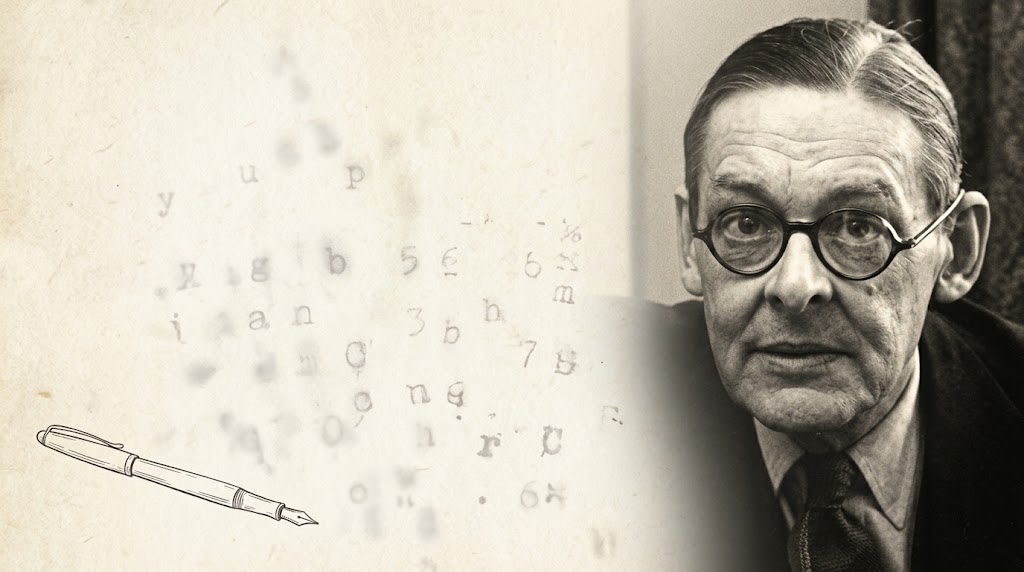
If you have ever read a poem that felt broken on purpose, jumping from one image to another with no clear story, there is a good chance it was influenced by T.S. Eliot. He is one of the most important poets of the 20th century, yet his writing can feel hard to approach at first. This guide explains who he was, what he wrote, and why people still read him today, in plain and simple English.
T.S. Eliot at a glance
| Fact | Detail |
|---|---|
| Full name | Thomas Stearns Eliot |
| Born | 26 September 1888, St. Louis, Missouri, USA |
| Died | 4 January 1965, London, England |
| Nationality | Born American, became a British citizen in 1927 |
| Known for | Modernist poetry, essays, and plays |
| Most famous poem | The Waste Land (1922) |
| Major award | Nobel Prize in Literature, 1948 |
Who was T.S. Eliot?
T.S. Eliot was a poet, essayist, editor and playwright. He was born in the United States but spent most of his adult life in England, and he eventually became a British citizen. Many readers assume he was British from the start, which is one of the most common misunderstandings about him. He is considered one of the leading figures of a literary movement called Modernism, a style that broke away from older, more traditional ways of writing poetry.
Early life and education
Eliot grew up in St. Louis in a well-educated family. He studied philosophy at Harvard University in the United States, then continued his studies in Paris and later at Oxford University in England. In 1914, he moved to England, and he never really left. London became the center of his writing life, and England eventually became his permanent home.
How Eliot changed the way poetry was written
Before Eliot, poetry in English often followed clear rhythms, rhymes and a single clear voice. Eliot's poetry did something different. He wrote in fragments, mixed different voices and styles together, and jumped between images without explaining the connections. At first, this confused many readers. Over time, it became one of the defining features of modern poetry. He believed a poem did not need to explain a poet's personal feelings directly. Instead, he argued that a poet should use outside images, objects or situations to suggest an emotion, an idea he explained in his essays and which later critics called the "objective correlative."
His most famous poems
The Love Song of J. Alfred Prufrock (1915)
This was Eliot's first major poem, and it is still one of his most read works today. It follows the inner thoughts of a nervous, hesitant man who struggles to say what he really feels. It was unusual for its time because of its broken structure and self-doubting tone, and it is often the first Eliot poem students are introduced to.
The Waste Land (1922)
This is Eliot's most famous and most studied poem. Written after the First World War, it reflects a broken, exhausted and uncertain world. The poem moves through many different voices, languages and literary references, which makes it feel more like a collage than a single story. It is widely considered one of the most influential poems in English literature, and it was heavily edited with help from fellow poet Ezra Pound, who cut large sections of the original draft.
The Hollow Men (1925)
A shorter, darker poem that explores feelings of emptiness and spiritual loss. It continues many of the themes found in The Waste Land, written in an even more stripped-down style.
Four Quartets (1943)
This later work is made up of four separate poems, each tied to a specific place. It is more reflective and spiritual than his earlier writing, focused on time, memory and faith. Many critics consider it the finest achievement of his later career, written after his religious conversion.
Eliot's religious conversion
In 1927, the same year he became a British citizen, Eliot was baptized into the Church of England. This was a major turning point in his personal life and in his writing. His earlier poems focus on confusion, emptiness and a broken modern world. His later work, especially Four Quartets, leans much more toward faith, meaning and spiritual searching.
Not just a poet: plays, essays and publishing
Eliot did not only write poems. He worked for years at the publishing house Faber and Faber, where he helped discover and support other important writers. He also wrote plays, including Murder in the Cathedral, about the killing of Archbishop Thomas Becket, and The Cocktail Party, a drawing-room drama. His essays, especially one called "Tradition and the Individual Talent," had a huge influence on how later generations of critics thought about poetry and literary history.
The surprising link to the musical Cats
Here is a detail that surprises a lot of people. In 1939, Eliot published a lighthearted book of poems for children called Old Possum's Book of Practical Cats, full of playful poems about different cat characters. Decades later, composer Andrew Lloyd Webber turned these poems into the hit musical Cats, which became one of the longest-running shows in theatre history. It is a strange contrast to his serious, difficult poetry, but it shows just how wide his range as a writer really was.
Nobel Prize and later recognition
In 1948, Eliot won the Nobel Prize in Literature, recognizing his influence on modern poetry. By this point, he was already one of the most respected literary figures in the English-speaking world, admired both for his own writing and for the writers he had supported as an editor.
Why T.S. Eliot still matters today
Eliot's influence on poetry did not stay in the past. His style opened the door for poets to write in broken, non-linear and layered ways, which is now a common technique in modern poetry. His essays shaped how literature is taught and discussed in universities. And his poems, especially The Waste Land and Prufrock, are still studied because they capture a very specific feeling: uncertainty, searching, and trying to find meaning in a confusing modern world, a feeling that still connects with readers today.
Common misconceptions about T.S. Eliot
- "He was British his whole life." He was actually born and raised in the United States, and became a British citizen only in 1927.
- "His poetry is impossible to understand." It can be challenging at first, but his poems are built around strong, clear images and emotions once you know the context behind them.
- "He only wrote serious, difficult poetry." He also wrote playful children's poems, which later became the musical Cats.
Frequently asked questions
What is T.S. Eliot's most famous poem?
The Waste Land (1922) is widely considered his most famous and most influential poem, though The Love Song of J. Alfred Prufrock is often the first poem people read.
Was T.S. Eliot American or British?
Both, in a sense. He was born in the United States in 1888, moved to England in 1914, and became a British citizen in 1927, spending most of his adult life there.
Why did T.S. Eliot win the Nobel Prize?
He won the Nobel Prize in Literature in 1948 for his major contribution to modern poetry and his influence on how poetry was written in the 20th century.
Is T.S. Eliot connected to the musical Cats?
Yes. His 1939 poetry collection, Old Possum's Book of Practical Cats, was the basis for Andrew Lloyd Webber's musical Cats.
Why is T.S. Eliot's poetry considered difficult?
His poems often skip clear explanations, mix multiple voices and references, and jump between images rather than telling a simple story. This style, often associated with Modernism, rewards slow, careful reading rather than a quick first pass.
T.S. Eliot remains one of those writers whose influence is bigger than his own body of work. Even if you have never read a full poem of his, the broken, image-driven style of much of today's poetry owes something to what he started over a hundred years ago.