
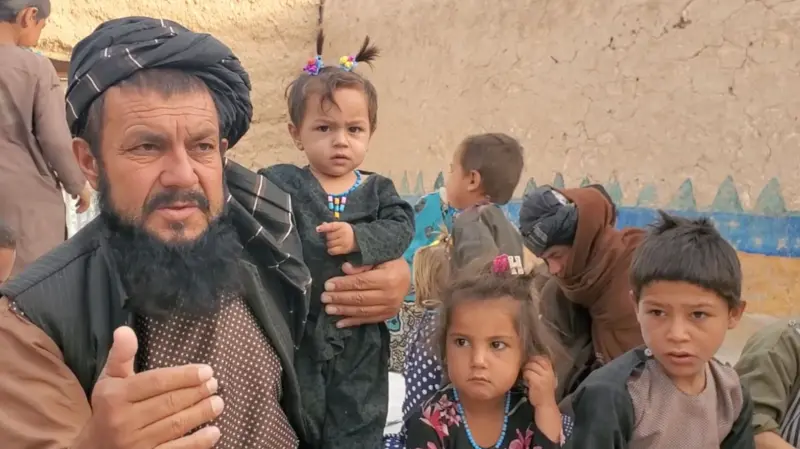
Picture a home where, the moment food is laid out, dozens of small hands reach for bread at once, yet many nights there simply isn't enough to go around, and several children go to bed hungry. This isn't a scene from fiction. It's the daily reality for 57-year-old Mohammad Sadiq, who lives in the Khero Karez area of Tarinkot, the capital of Afghanistan's central Uruzgan province.
The British broadcaster BBC recently aired a detailed documentary on Mohammad Sadiq's life as part of its "BBC Global Women" series, reigniting a worldwide conversation about poverty, extremely large families, and child marriage.
72 births, and 14 young lives lost
Mohammad Sadiq has four wives, who have together given birth to 72 children. However, due to the lack of basic healthcare, malnutrition, and severe poverty common in a remote region like Uruzgan, 14 of his children did not survive. His living children currently number 58 (up from 52 in May 2024, meaning six more have been born in the past two years).
Speaking about his enormous family, Mohammad Sadiq says his main motivation for having so many children was to "increase the numbers of the Muslim ummah." Without the resources to match, however, supporting a family this size has become a burden beyond what he can manage.
When a father forgets his own children's names
A person's children are usually central to their identity, but when the number crosses fifty, even memory gives out. Mohammad Sadiq faces exactly this problem:
- Calling out without names: he's unable to remember all 58 of his children's names, so whenever he needs to call one over, he simply says "my son" or "my daughter."
- A mix-up at a wedding: speaking to the BBC, he recounted an incident at one of his daughters' weddings where he forgot her real name and accidentally gave the officiating cleric the name of a different daughter instead.
- A head count at mealtimes: children are routinely counted at meal times. Often the count comes up short by one or two, and it later turns out that child was staying with a relative or neighbor.
An income of 1,000 Afghanis, and children collecting fuel from trash
Financially, keeping a household of 63 people (Sadiq, his four wives, and 58 children) running is nothing short of a daily miracle. Mohammad Sadiq works as a commission agent at a local car dealership. When a car sells, he earns just 1,000 Afghanis (roughly $15) in commission. Cars obviously don't sell every day, and even when they do, this modest sum isn't enough to cover a single meal for a family this large.
Several of his older sons work as laborers to keep the household stove running, while his youngest children, who should be at school or playing, instead collect paper and plastic from the streets and garbage heaps to burn for warmth.
A house with no doors, and seven people under one blanket
The picture the BBC report paints of the family's living conditions is harrowing:
- Curtains instead of doors: the mud house the family lives in has no conventional wooden or metal doors or windows in its rooms. Thin cloth curtains are hung over doorways as the only barrier against heat and cold.
- A single, shared, unsafe washroom: the whole household shares one small, unsafe space for bathing, washing clothes, doing dishes, and at times, using the toilet.
- Sleeping arrangements: on freezing winter nights, there aren't enough blankets and bedding to go around, forcing six or seven people to huddle together under a single thin blanket.
- Two meals a day: the stove is lit only twice a day, for breakfast and dinner, with two of the wives sharing cooking duties. In summer, everyone eats together in the courtyard; in winter, inside the rooms.
Child marriage and the looming risks to maternal health
Another deeply sensitive dimension of this story concerns women's rights and health. Mohammad Sadiq himself acknowledged that he married for the first time at age 20, and took some time between each subsequent marriage to gather the "walwar" (bride price). But all four of his wives were between 13 and 16 years old when they married him.
According to medical experts and human rights organizations, marrying this young, followed by repeated pregnancies without any real gap (across the four women, a combined 72 pregnancies), takes a severe toll on mothers' physical and mental health. In remote areas like Uruzgan, where maternity centers and female doctors are in critically short supply, this combination often proves fatal for mothers and newborns alike, which is exactly why 14 of this family's children did not live to grow up.
A hope for the future: "just enough bread, and an education"
Despite being illiterate himself, Mohammad Sadiq still holds onto a dream of a better future for his children. He wants them to go to school and study their way out of this cycle of poverty (one of his young daughters has told local media she hopes to become a doctor), but the cost of notebooks, textbooks, and school fees remains the biggest obstacle in their way.
Mohammad Sadiq has appealed to the local government, international aid organizations, and wealthy businesspeople for help. His life now holds just two major wishes left: that his children have enough food to eat, and that they can be adorned with the jewel of education.
This story isn't just the hardship of one man or one family. It's a mirror held up to millions of families across a war-torn, economically crippled Afghanistan, where ignorance, poverty, and a lack of resources are quietly swallowing the future of generations yet to come.