
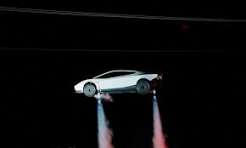
On October 15, 2026, Elon Musk stood on a stage at a SpaceX test facility in Texas and did something people have been waiting on for almost nine years: he unveiled the next-generation Tesla Roadster, and claimed it can fly. The internet immediately lit up. But what actually happened on that stage, and is this really the flying car we've all joked about for decades? Here's the full story.
The quick facts
| Detail | What we know |
|---|---|
| Unveiled | October 15, 2026, at a SpaceX test facility in Texas |
| Does it actually fly? | Not in the traditional sense, Musk himself calls it "hopping," not sustained flight |
| Technology | High-pressure cold-gas thrusters (10 nozzles) plus a fan-based suction system, developed with SpaceX |
| Claimed 0-60 mph | As fast as 0.8 seconds with thrusters engaged |
| Top speed goal | Over 230 mph, with a long-term goal of "half the speed of sound" |
| Production target | 2028 (per Musk, subject to Tesla's long history of delays) |
| Is the flying feature road-legal? | No, Tesla's own site says it isn't approved for public roads |
| Reservation cost | $50,000 ($5,000 deposit plus $45,000 within 10 days) |
What actually happened at the unveiling
The demonstration was dramatic by any standard. The Roadster drove up a towering, curved ramp that curled over at the top, so the car was briefly upside down, seemingly clinging to the surface through sheer suction before launching off the end, flipping through the air, and landing safely as the crowd cheered. Notably, there was no driver inside during the demo, which Musk said was "to make sure we don't kill anyone."
In a second demonstration, the car launched into the air and performed what Tesla described as a "kickflip" over a row of five parked Tesla vehicles. Musk's simple reaction afterward: "Well, it worked."
Lars Moravy, Tesla's vice president of vehicle engineering, who presented alongside Musk, explained that the car uses a fan suction system on its underside capable of pulling up to 2 Gs, strong enough to let it stick to surfaces and drive upside down. He added, perhaps a little too honestly, that it's "not necessarily a safety-optimized car."
How does the "flying" technology actually work?
The system is built around two main components, developed in partnership with SpaceX:
- Ultra high-pressure air tanks and nozzles: ten nozzles positioned around the car release compressed air (described as cold-gas thrusters, the same basic principle used on spacecraft) to propel the car off the ground and control it briefly in the air.
- A fan-based suction system: mounted underneath the car, this generates strong downforce, enough to pull around 2 Gs, which is what let the Roadster cling to the curved ramp while upside down.
Together, these let the car perform short, controlled launches, flips, and landings, more like a very advanced, very expensive stunt car than a vehicle capable of actual sustained flight.
So is it really a "flying car"?
Here's the honest answer: not in the way most people picture a flying car. An aviation expert who spoke to CNN described the capability as "closer to hopping" than flying. Musk himself was fairly direct about this at the event, saying, "We're not talking about sustained flight. We are literally talking about hopping." The car cannot cruise through the air the way a plane or drone does; it performs brief, dramatic, thruster-assisted launches and lands again shortly after.
For genuine sustained flight, companies like California-based Alef Aeronautics are taking a very different approach. Alef's prototype flying car uses eight propellers (four front, four back) and weighs only about 254 pounds, a tiny fraction of a Tesla Roadster's weight, and can carry just one passenger who must weigh less than the vehicle itself. It's a fundamentally different, much lighter design built around actual flight rather than a brief, powerful hop.
A nearly decade-long wait
To understand why this unveiling was such a big moment, it helps to know the backstory. Tesla first revealed the next-generation Roadster back in 2017, promising production by 2020, a 0-60 mph time of 1.9 seconds, a 620-mile range, and a base price around $200,000. None of that happened on schedule. The car was delayed repeatedly, with Tesla citing supply chain issues, chip shortages, and a focus on scaling up Model Y production instead.
Reservation holders, who put down $50,000 deposits (split into a $5,000 initial payment and $45,000 within ten days), were left waiting for years. Some well-known names eventually gave up: YouTuber Marques Brownlee reportedly cancelled his reservation after roughly eight years of waiting, and OpenAI CEO Sam Altman cancelled his after about seven and a half years. Tesla has described the deposits as fully refundable, though some reservation holders have reported difficulty actually getting their money back.
Musk has teased flying or hovering capability for the Roadster since that original 2017 reveal, originally floating the idea of a "SpaceX option package" with around ten small rocket thrusters. His public comments on flying cars in general have been mixed over the years, he expressed skepticism about noise and safety in a 2017 TED talk, while also saying elsewhere that he wasn't fundamentally opposed to the idea.
Price, specs, and how to reserve one
As of the unveiling, Tesla has not confirmed a final price. The original 2017 pricing pointed to roughly $200,000 for the base car and $250,000 for a "Founders Series" edition, but after nine years of inflation and what appears to be a substantial redesign (including a carbon-fiber-tub architecture and butterfly doors), the real number is expected to be higher. Tesla's current reservation terms describe any quoted price as an estimate only.
Reservations are open again, with three variants listed: Performance, Thrust, and Rocket, the last of which presumably refers to the thruster-equipped version. Reserving a spot requires the same $50,000 total as before. Tesla's website is clear that the flying/thruster capability itself is not approved for public road use, so buyers hoping to actually use that feature will be limited to private or controlled settings, at least for now.
Musk has stated that production will begin in 2028. Given Tesla's track record on Roadster timelines specifically, that date is worth treating as optimistic rather than firm.
Not everyone is convinced
Reaction hasn't been universal excitement. Ross Gerber, CEO of Gerber Kawasaki Wealth Management and a longtime Tesla investor, publicly questioned why the car needed hovering capability at all, suggesting it might end up being a limited-run novelty rather than a true production vehicle. The broader skepticism isn't really about whether the demo was impressive, it clearly was, but about whether "hopping" technology translates into a real, safe, regulation-compliant product that ordinary reservation holders will actually receive.
There's also a financial backdrop worth noting: Tesla's stock had fallen significantly over the course of the year leading up to this unveiling, even as broader tech indices rose, which has added extra pressure on Musk to deliver a genuine headline moment rather than another delayed promise.
Frequently asked questions
Can you actually buy a flying Tesla right now?
No. You can place a $50,000 reservation for the upcoming Roadster, but the flying/thruster capability is not approved for public roads, and Musk says production won't begin until 2028 at the earliest.
Does the Tesla Roadster really fly like a plane?
No. It performs brief, thruster-assisted "hops," controlled launches and landings, not sustained flight. Musk himself has described it this way.
How does the Tesla Roadster get off the ground?
Through a system developed with SpaceX: ten high-pressure air nozzles for propulsion, combined with a fan-based suction system underneath the car that can generate up to 2 Gs of downforce.
How much will the flying Tesla Roadster cost?
Tesla hasn't confirmed a final price. Original 2017 estimates put the base Roadster around $200,000, but the price is expected to be higher after years of redesign and inflation.
Is there an actual flying car already available?
Not widely, but companies like Alef Aeronautics are developing genuine flying cars using a lighter, propeller-based design, a very different approach from Tesla's thruster-assisted Roadster.
Whatever you make of it, the demo was undeniably a spectacle, and it's reignited a conversation about flying cars that's been simmering since the 1960s. Whether the Roadster actually reaches production in 2028 with its thruster package intact, or quietly becomes another delayed Tesla promise, is a question only time will answer.