
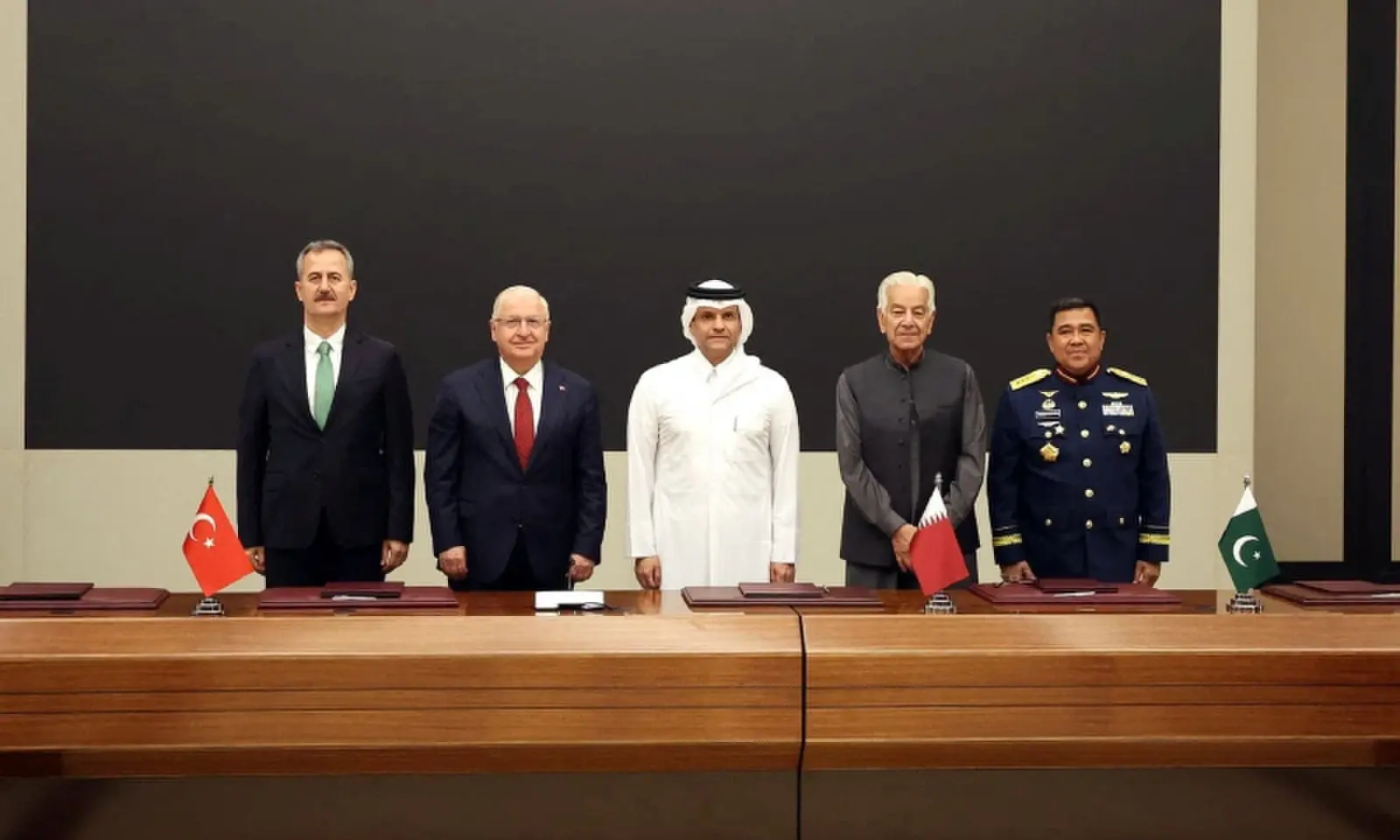
Amid fast-changing global and regional politics, four of the Muslim world's most important powers — Pakistan, Türkiye, Qatar, and Indonesia — have taken a historic step toward defence self-reliance and military technology cooperation. On October 21, 2026, in Doha, the capital of Qatar, the four countries signed a multilateral defence agreement named the "Badr Memorandum of Understanding," also known as the "Badr MoU" or "Badr Agreement."
In this article, we look at what the agreement is, why it was named "Badr," why it has emerged now and under what circumstances, and what benefits it could bring to Pakistan and the wider region.
What Is the Badr MoU?
The Badr MoU is, at its core, a strategic agreement among the four countries on defence production, building up military capabilities, and exchanging technology. Its aim goes beyond buying and selling weapons: the goal is to link the four countries' defence industries and jointly develop modern weapons and defence systems.
Senior defence officials from all four countries signed at the ceremony:
| Country | Signatory |
|---|---|
| Pakistan | Defence Minister Khawaja Muhammad Asif |
| Türkiye | Defence Minister Yaşar Güler, with Haluk Görgün, head of Türkiye's defence industry, present at the ceremony |
| Qatar | Deputy Prime Minister and Minister of State for Defence Sheikh Saoud bin Abdulrahman bin Hassan Al Thani |
| Indonesia | Deputy Defence Minister Yusuf Jauhari |
Why Is the Agreement Called "Badr"?
Explaining the name, Qatar's official news agency (QNA) said that in Arabic, "Badr" means "the full moon of the fourteenth night." According to the official position, just as the full moon gives complete light, the four countries will combine their separate defence, economic, and technical strengths to complement one another and form a complete defence bloc. Under the agreed terms, other friendly nations may also join the agreement in the future.
The deeper message of the name, however, lies in its historical background. Beyond the diplomatic statements, this is an alliance of four major Muslim countries, and the word "Badr" immediately brings to every Muslim's mind the first decisive battle in Islam's history — the Battle of Badr — where Muslims, despite limited resources, defeated a larger power through unity and strategy.
Naming this military agreement "Badr" is therefore a strong ideological and strategic message in itself. Although the document leaves room for "friendly nations" to join, the title makes clear that the spirit and axis of this alliance are Muslim countries, and that it is both a symbolic and practical effort by the Islamic world to strengthen its own defence system.
Key Objectives of the Badr MoU
According to statements issued by the defence ministries of Türkiye, Qatar, and Pakistan, the main points of the agreement are:
- Joint defence production: The four countries will pool the expertise of their defence industries to jointly manufacture military equipment.
- Technology transfer: Moving away from the traditional model of buying finished weapons, the countries will transfer technology to one another to develop local infrastructure and human resources.
- Joint research and development: Joint R&D projects will be launched with future war-fighting needs in mind.
- Training: Technical and professional training programmes between the four countries' armed forces will expand.
The agreement carries major economic significance as well as defence value. It will not only meet the four countries' own defence needs but also allow defence products to be supplied to other allied and friendly nations.
Pakistan's Position: Self-Reliance and Regional Peace
Pakistan's Defence Minister Khawaja Asif described the agreement as a milestone for regional peace and stability. According to him, Pakistan attaches great importance to defence cooperation with its trusted partners, and the agreement will greatly help Pakistan in achieving defence self-reliance, industrial cooperation, and access to modern technology.
Why Did This Agreement Emerge Now? The Background
The Badr MoU did not emerge in a vacuum. According to Al Jazeera's reporting, it comes at a time when countries in the region are trying to widen their circle of security partners against the backdrop of a long war between the United States and Israel on one side and Iran on the other. Experts say current conflicts and uncertainty have pushed the region to speed up efforts to strengthen its own military capability.
The roots of this development go back to another important event. On September 9, 2025, Israel carried out an air strike in Doha targeting Hamas leadership. According to a Financial Times report, the strike badly shook the Gulf states' sense of security and reinforced long-standing concerns about America's unpredictable policy and its commitment to defending its Gulf allies. Two days after the strike, an extraordinary joint meeting of the Arab League and the Organisation of Islamic Cooperation (OIC) was also convened.
Against this backdrop, on September 17, 2025, Pakistan and Saudi Arabia concluded a formal Strategic Mutual Defence Agreement, under which an attack on either country would be treated as an attack on both. According to an official, it is a "comprehensive defence agreement covering all military means" — meaning it is also understood to include the possible use of Pakistan's nuclear weapons if required, which makes the agreement especially significant for the region.
Other Similar Alliances Taking Shape in the Region
The Badr MoU is a continuation of several regional defence arrangements formed in recent months:
| Arrangement | Details |
|---|---|
| Makkah Defence Alliance | Pakistan, Türkiye, and Saudi Arabia are already part of this alliance, under which an attack on any one member is treated as an attack on all. Qatar also welcomed the alliance. |
| Regional Four (R4 Group) | In March, the "R4 Group" of Pakistan, Türkiye, Saudi Arabia, and Egypt emerged, and remains active on regional issues. |
| Mediation in the US-Iran war | Islamabad and Doha have played key mediating roles in the recent US-Iran tensions and war. |
| Pakistan–Qatar–Indonesia military ties | In November 2025, during President Asif Ali Zardari's visit to Qatar, an offer was made to expand defence production. This year, Indonesia's defence minister and, last month, Indonesian Navy chief Admiral Dr. Muhammad Ali met the Chief of Defence Forces and Army Chief Field Marshal Asim Munir in Rawalpindi, agreeing to take joint exercises and defence cooperation to new heights. |
Global Reaction: India Watches Closely
India is also closely watching the new defence arrangements taking shape across the region. When Pakistan and Saudi Arabia concluded their mutual defence agreement in September 2025, India officially said it would "study the implications of this development." Political analyst Ian Bremmer said at the time that the agreement could change India's security strategy, especially if Saudi Arabia is truly committed to defending Pakistan in the event of a conflict. Now, with the Badr MoU, which also brings in Türkiye and Indonesia — powers with large Muslim populations — this new defence bloc has widened further.
What We Still Don't Know
The final, detailed terms of the agreement have not yet been fully made public, and more details — along with the possible entry of other countries — are expected in the coming months.
Author's Analysis: Is an "Islamic NATO" Taking Shape?
My own reading is that the Makkah Accord and the Badr Agreement will not be the last of their kind. The Middle East's trust in the United States as a reliable security guarantor has eroded. The recent Iran–Israel war, the war in Gaza, and the strike on Doha have pushed regional states to ask a hard question: if their security is threatened, who will actually stand with them? When that question has no comfortable answer, countries start building their own answers.
That is why I expect more agreements of this kind across the Islamic world. Each one adds a different layer: the Pakistan–Saudi pact and the Makkah Accord provide a collective-security layer, while the Badr MoU adds an industrial and technological layer through joint production, research, and technology transfer. Taken together, they look less like isolated deals and more like building blocks.
In my view, it is entirely possible that one day all of these separate defence agreements will be brought under the shadow of one larger framework — something that, whatever it is formally called, would function as an "Islamic NATO." I do not claim this is certain, but the direction of travel is hard to miss.
There are real obstacles, and they deserve mention. Defence analysts in Islamabad have already cautioned against treating the Makkah arrangement as the equivalent of NATO, and the Badr MoU itself, as described, is a defence-industry framework rather than a collective-defence clause. Member states also have different threat perceptions and different relationships with Washington: Qatar, for example, says it is working with partners including the United States, the United Kingdom, and France to develop its own defence capabilities. Turning a web of agreements into a single alliance would require political will that is yet to be tested. Still, even if the destination is uncertain, the momentum is real — and it is worth watching closely.
Frequently Asked Questions
What is the Badr MoU?
The Badr MoU is a multilateral defence agreement signed by Pakistan, Türkiye, Qatar, and Indonesia in Doha on October 21, 2026. It focuses on joint defence production, technology transfer, joint research and development, and military training.
Who signed the Badr MoU?
Pakistan's Defence Minister Khawaja Muhammad Asif, Türkiye's Defence Minister Yaşar Güler, Qatar's Deputy Prime Minister and Minister of State for Defence Sheikh Saoud bin Abdulrahman bin Hassan Al Thani, and Indonesia's Deputy Defence Minister Yusuf Jauhari.
Why is it called "Badr"?
According to Qatar's official news agency, "Badr" means "the full moon of the fourteenth night" in Arabic, symbolising how the four countries' strengths complement one another. The name also evokes the Battle of Badr, a symbol of unity and strategy overcoming limited resources.
Is the Badr MoU a mutual defence pact like NATO?
As described, the Badr MoU focuses on defence production, technology sharing, research, and training rather than a collective-defence clause. Mutual-defence commitments exist in separate arrangements such as the Pakistan–Saudi Strategic Mutual Defence Agreement and the Makkah Defence Alliance.
Can other countries join the Badr MoU?
Yes. Under the agreed terms, other friendly nations may join in the future.
What does the Badr MoU mean for Pakistan?
According to Defence Minister Khawaja Asif, it will help Pakistan achieve defence self-reliance, industrial cooperation, and access to modern technology, while supporting regional peace and stability.