
When Israel was founded in May 1948, it was a small, new country surrounded by neighbours that did not accept it. Within hours, the United States became the first country to recognise its provisional government.
That moment started one of the longest aid relationships in modern history. It did not start big. In the early years, American help was mostly small economic loans and food aid — enough to help a new state stand on its feet, not enough to build an army.
Everything changed after the wars of 1967 and especially 1973. After the Yom Kippur War in 1973, Washington decided Israel was not just a friend, but a key partner in a tense Middle East. From then on, the money grew, and it kept growing for decades.
So, how much has America actually given Israel?
Here is the simple answer, and then why you sometimes see different numbers in the news.
In plain cash, without adjusting for inflation, the United States has given Israel $175 billion from 1946 through fiscal year 2025. That is the Congressional Research Service (CRS) total: $124.5 billion in military aid, $34.3 billion in economic aid, and $16.1 billion for missile defence.
But a dollar in 1979 was worth much more than a dollar today. If you adjust for inflation, the same history is worth about $300 billion in today's money — about $298 billion on the CRS/State Department basis for 1946–2024, and about $330 billion on the Council on Foreign Relations (CFR) chart for the same period.
So when you see $175 billion, $300 billion and $350 billion in different articles, nobody is necessarily lying. They are just pricing the same history in different ways. The cash total is $175 billion. In today's money, it is roughly $300 billion and more.
For most of recent history, the pattern was steady: under a 2016 agreement, the US promised Israel $3.8 billion a year through 2028 — $3.3 billion for weapons and $500 million for missile defence. Congress still has to approve it each year, but that $3.8 billion became the normal baseline.
Then came 7 October 2023, and the baseline broke.
The Hamas war: when American help surged
On 7 October 2023, Hamas attacked Israel, killing about 1,200 people. Israel went to war in Gaza, and later fought Hezbollah in Lebanon and clashed with Iran. The United States did not just send statements of support. It sent weapons, and it sent them fast.
By law, Congress approved at least $16.3 billion in direct military aid after October 2023. That includes an $8.7 billion emergency package in April 2024 — $3.5 billion for weapons purchases and $5.2 billion for missile defence, including Iron Dome, David's Sling and the new laser system, Iron Beam — plus the normal $3.8 billion in each of fiscal 2024 and 2025.
But that is not the whole story. A wider count by Brown University's Costs of War project, which also includes weapons taken from American stockpiles in Israel, ammunition and money to rebuild US weapons stocks, puts the total military aid provided by September 2025 at $21.7 billion — $17.9 billion in the first year of the war, and $3.8 billion in the second.
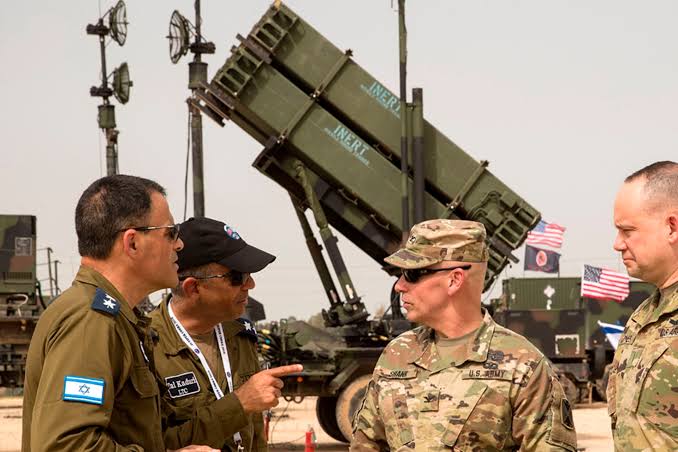
What did that mean on the ground? In May 2025, Israel's Defence Ministry said the US had delivered 90,000 tons of arms and equipment since October 2023, on 800 planes and 140 ships: tank shells, artillery ammunition, bombs, rockets and small arms, plus interceptors to keep Iron Dome firing.
There is one important difference to keep in mind. “Aid provided” is not the same as “weapons already delivered.” By August 2025, researchers estimated only about $4.2 billion in weapons had actually been exported from the United States. The rest was money committed, weapons in production, or sales agreed for the future — including about $39 billion in active arms sales cases in April 2025. In other words, America promised much more, much faster, than factories and planes could deliver.
How big was that help compared with Israel's own war bill? Israel's own gross war cost for 2023–2025 was estimated by the Bank of Israel at about $67.6 billion. Against that, $21.7 billion in US military aid is about one-third. If you also add the $70 billion the UN, EU and World Bank say will be needed to rebuild Gaza, the American share falls to about one-sixth. Both figures are true — it just depends what you count as “the cost of the war.”
American forces also spent $9.65–$12.07 billion of their own money on operations in Yemen and the wider region linked to the war. That is not aid to Israel, and it should not be counted as aid, but it is part of what the war cost America in total: $31.35–$33.77 billion for aid plus US operations combined.
And the other countries? Why did America help them?
Israel is first by a very large margin — almost double the next country. But it was never the only country America helped, and each of the others had a different reason. These totals are in today's money (constant 2024 dollars, 1946–2024):
Country | Total aid | Why America helped, in one line |
|---|---|---|
Israel | $330bn | A close ally since 1948, seen in Washington as a democratic partner and a security anchor in the Middle East. |
Egypt | $179bn | After the 1979 peace treaty with Israel, the US paid Egypt to keep that peace, protect the Suez Canal route, and stay a stable partner. |
Afghanistan | $171bn | First, in the 1980s, to help Afghans fight the Soviet Union; then, after 2001, to fight al-Qaeda and the Taliban and rebuild the country. |
South Vietnam | $154bn | During the Cold War, the US tried to stop communism spreading in Southeast Asia — the Vietnam War. South Vietnam no longer exists. |
Iraq | $106bn | After the 2003 invasion, America spent heavily to rebuild Iraq, train its army, and later fight ISIS. |
Ukraine | $105bn | Mostly after Russia's full-scale invasion in 2022: to help Ukraine defend itself and to deter Russia in Europe. |
South Korea | $102bn | After the Korean War, the US helped rebuild South Korea and kept troops there to deter North Korea. |
United Kingdom | $93bn | After the Second World War, America helped rebuild Britain — almost all of it economic aid, not weapons. |
India | $88bn | Mostly food and development aid in the early decades, when India was poor and newly independent; later, a growing strategic partner. |
Turkey | $87bn | A NATO ally on the Soviet Union's southern border during the Cold War, and later a partner in the Middle East. |
France | $84bn | Post-war reconstruction after the Second World War, through the Marshall Plan and related aid. |
Pakistan | $82bn | A Cold War ally, a key partner in the 1980s Afghan war against the Soviets, and again after 2001 in counter-terrorism. |
The pattern is clear: America usually gives big aid for one of three reasons — to rebuild after a war, to win a Cold War or regional contest, or to keep a peace deal or an alliance alive. Israel is unusual because all three reasons applied, and the help never really stopped.
Why does this still matter?
Supporters of the aid say it keeps Israel safe, keeps American weapons factories working, and helps both countries face a common threat, above all Iran. Critics say Israel is now a wealthy country that can pay for its own defence, and that the aid should be reduced or phased out. That debate will come to a head in 2028, when the current $3.8-billion-a-year agreement runs out.
Whatever side of that debate you are on, the numbers themselves are now clear. From a few small loans in the 1950s to $12.5 billion in a single war year in 2024, American help to Israel grew from a gesture of friendship into one of the biggest aid relationships the world has ever seen — and the war with Hamas made it bigger, faster, than at any time in decades.
Sources in brief: Congressional Research Service RL33222 (28 May 2025); Council on Foreign Relations, “U.S. Aid to Israel in Four Charts” (updated 7 October 2025); William D. Hartung, Costs of War, Brown University (7 October 2025); SIPRI, Trends in International Arms Transfers, 2024; Bank of Israel war-cost estimates for 2023–2025; UN/EU/World Bank Gaza reconstruction assessment via UNDP (14 October 2025). Full tables, methodology and references are in the detailed version of this report.