
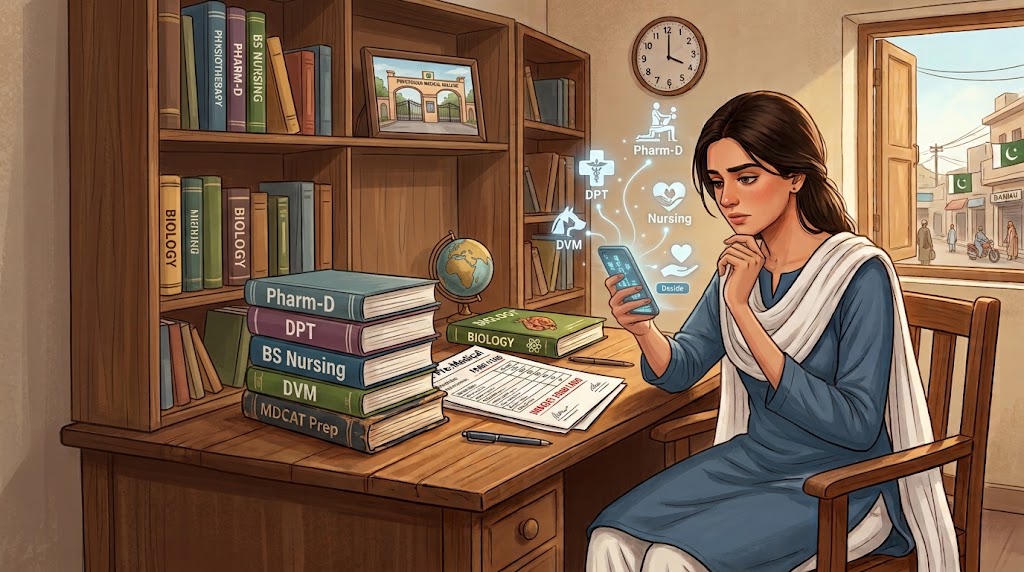
Your FSc result is out, relatives are calling, and every second person says the same thing: "Beta, doctor hi banna hai na?" Meanwhile you are sitting there with a decent score, an MDCAT date that feels too close, and no real idea what happens if the MBBS seat does not come. If this sounds like your house, relax. Thousands of Pre-Medical students in Pakistan are in the same spot every single year, and most of them figure it out. This guide walks through what you can actually do after FSc Pre-Medical, what each path really looks like, and how to decide without panicking.
The quick answer: what can you do after FSc Pre-Medical?
MBBS is the most famous option, but it is not the only one. With Pre-Medical you can also go for BDS, Pharm-D, DPT, DVM, BS Nursing, BS MLT (Medical Lab Technology), Nutrition and Dietetics, Biotechnology, Microbiology, Psychology and several other BS programs. Some students even switch to IT or business through bridging courses. The right choice is not the one with the loudest "scope" talk. It is the one you can study seriously for 4 to 5 years and turn into a job.
First, a hard truth about MBBS
MBBS is five years of study plus a one-year house job. Seats in good public medical colleges are limited, and every year far more students sit the MDCAT than there are government seats. That does not mean you should not try. It means you should try with a plan B already written down, not after the merit list is out and you are in shock.
Take a student like Areeba from a small town in Khyber Pakhtunkhwa. She scored well in FSc, studied hard for MDCAT, and missed the government merit by a few marks. She had never looked at any other option, so she lost almost two months deciding what to do next. Her cousin Hamza, in a similar position, had already shortlisted Pharm-D and DPT before the result. He applied within a week. Same marks, same stress, very different year. The only difference was that one of them had a plan B.
Your main options after FSc Pre-Medical
1. MBBS (5 years + 1 year house job)
The classic route. You study medicine, do your house job, and then specialise in surgery, paediatrics, medicine or something else. The road is long and the workload is heavy, but it remains the top choice for students who really want to practise as doctors. Be ready for the fact that your twenties will mostly be about books and hospital duty.
2. BDS (4 years)
Dentistry is a practical, hands-on field. You can work in hospitals, join a clinic, or open your own practice later. Many students ignore BDS because it is not as "famous" as MBBS, but a good dentist with a clean setup can build a steady practice, especially in growing cities.
3. Pharm-D (5 years)
Doctor of Pharmacy is for students who like chemistry and detail work. After graduation you can work in a hospital pharmacy, in the pharmaceutical industry (production, quality control, regulatory affairs, sales) or in clinical roles. Think of a student who always enjoyed chemistry practicals more than biology diagrams. Pharm-D usually fits that person better than forcing MBBS.
4. DPT (5 years)
Doctor of Physical Therapy trains you to help patients recover after injuries, strokes, surgeries and back problems. You work with patients directly, which suits people who want visible results. A DPT graduate can join a hospital, a rehab centre, a sports team or start a private clinic. The demand for physiotherapists in Pakistan has been growing as more people look for treatment beyond medicines.
5. DVM (5 years)
Veterinary medicine does not get much attention, but Pakistan has a huge livestock and dairy sector. A veterinarian can work in animal hospitals, private clinics, dairy and poultry farms or government livestock departments. If you are comfortable around animals and do not mind field work, this is worth a look.
6. BS MLT (4 years)
Medical lab technologists run the tests that doctors depend on. No lab report, no diagnosis. Hospitals and private diagnostic labs both hire for this, and the work is more desk-and-lab than patient-facing. It suits quiet, careful people.
7. BS Nursing (4 years)
Nursing has steady demand at home and abroad. It involves shift duty and real hospital pressure, so you should be sure about the routine. Students who are disciplined and good with people usually do well here.
8. Other BS programs (4 years)
Biotechnology, Microbiology, Biochemistry, Zoology, Botany, Genetics, Nutrition and Dietetics, Environmental Science and Psychology. These lead to research, lab work, teaching, food and health companies and, with further study, higher degrees abroad. Do not choose them only because the admission is easy. Check what job you would actually apply for after graduating.
Quick comparison
| Field | Duration | Work style | Best for |
|---|---|---|---|
| MBBS | 5 years + house job | Hospital, clinic, long hours | Students ready for a long, tough road |
| BDS | 4 years | Clinic, hands-on procedures | Practical, detail-oriented students |
| Pharm-D | 5 years | Hospital, industry, lab | Chemistry lovers |
| DPT | 5 years | Direct patient rehabilitation | People who like hands-on care |
| DVM | 5 years | Clinic, farms, field work | Animal lovers |
| BS MLT | 4 years | Lab-based | Careful, focused students |
| BS Nursing | 4 years | Wards, shifts | Disciplined, people-focused students |
Fees, merit and seats differ a lot between institutes and provinces, so always check the latest admission notice of the university you are applying to.
Not everyone should stay in medical
Some students finish FSc and realise, honestly, that they never wanted medicine. They were following the family. That is more common than people admit. With bridging courses, Pre-Medical students can move toward IT, business, marketing, teaching or journalism. Others prepare for the armed forces or competitive government exams. There is no shame in this. Changing direction at 18 is much cheaper than changing at 24 after wasting four years.
Look at Usman, a Peshawar student who got through FSc Pre-Medical but kept spending his free time learning video editing on YouTube. After one failed MDCAT attempt he chose a BS in a computer-related field and started freelancing on the side. Within a couple of years he had real clients. Not every story ends like that, but it shows that your FSc subjects do not lock you into one life.
How to decide: the 3-question test
- Can I realistically get in? Look at last year's merit and your expected marks honestly. Hoping is fine, but plan for the average case.
- Can I handle the daily routine? Hospital shifts, lab work, clinic hours, field visits. Watch a few "day in my life" videos and, better, talk to someone who actually works in that field.
- Can I name a real job I will apply for after graduation? If you cannot say "I will apply as a clinical pharmacist at this kind of place" or "I will join a diagnostic lab as a technologist", you are choosing a title, not a career.
If a field fails even one of these three, put it lower on the list. Then write down your top three options and one clear first choice.
How to prepare for MDCAT without burning out
- Start with your FSc books. Most MDCAT questions come from the syllabus you already studied, so do not run after ten different books.
- Solve past papers. They show you the pattern and your weak chapters faster than any lecture.
- Take timed tests. Knowing the answer is not enough if you cannot finish in time.
- Give English and Physics real time. Many students ignore them and lose easy marks.
- Follow the official notice. The test authority, syllabus and schedule can change from year to year, so check the PMDC and your provincial health department websites instead of relying on social media rumours.
Mistakes that cost students a year
- Waiting for the MDCAT result before thinking about any other option
- Choosing a field only because a cousin or neighbour said it has scope
- Ignoring weak subjects and hoping they will fix themselves
- Paying an "agent" or consultancy for a guaranteed seat (real admission never needs a secret payment)
- Not checking whether the college or programme is recognised by the relevant council, such as PMDC, the Pharmacy Council, or the Higher Education Commission
- Believing that the degree alone will get you a job without skills and communication
Frequently asked questions
What is the best career after FSc Pre-Medical in Pakistan?
There is no single best one. MBBS is the most popular, but BDS, Pharm-D, DPT, nursing and lab sciences all have real demand. The best one is the field you can study consistently and turn into a job.
What if I do not get into MBBS?
You still have many options: BDS, Pharm-D, DPT, DVM, BS MLT, nursing and several BS programs. Some students also retake MDCAT after a year. Decide early whether you are willing to repeat, because that choice affects everything else.
Can Pre-Medical students go into IT or engineering?
Yes, in many cases through bridging or additional courses, depending on the university. Check the eligibility rules of the specific programme before you apply.
Is Pharm-D a good career?
It can be, especially for students who like chemistry and want to work in hospitals or the pharmaceutical industry. Growth depends on your skills, communication and the direction you pick early on.
Do I need coaching for MDCAT?
Not always. Some students do well with self-study, past papers and a good teacher. Coaching helps if you need structure, but it is not magic. Your own practice matters more.
How early should I start planning?
Now. Even if you are still in FSc part one, write your top three options and one backup. It costs nothing and saves months later.
Final thoughts
FSc Pre-Medical does not mean you have to become a doctor, and it does not mean you failed if you do not. It means you have a strong science base and a lot of doors. Pick your top three, check the daily reality of each, keep a backup ready, and then commit to one. Which path are you leaning toward right now, and what is stopping you? Tell us in the comments.
Have your own FSc or MDCAT story, or advice you wish someone had given you? Send your voice and your writing to The Opinions. This platform exists for the voices that deserve to be heard.