
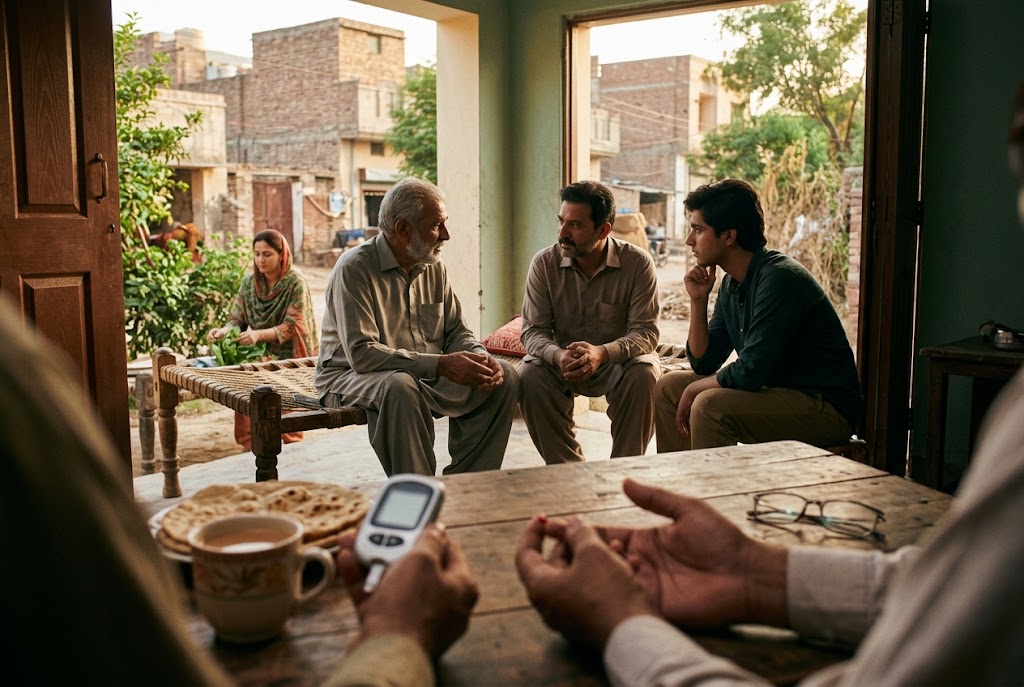
If your family members have diabetes, you may have asked yourself, “Will I develop it too?” The answer is not necessarily yes. A family history of diabetes can increase your risk of developing the disease, but it does not mean that diabetes is inevitable.
ABSTRACT
Do you know how Pakistan went from 5 million people with diabetes to 33 million in just 16 years? Is Pakistan now becoming the diabetes capital of the world? The disease that our grandparents used to manage quietly is now spreading rapidly, making Pakistan one of the countries with the highest diabetes prevalence in the world, at 33.3%.
Contributing factors to this alarming rise include genetic factors, urbanization, poor dietary habits, the consumption of unhealthy and processed foods, obesity, a lack of awareness, and low literacy rates. Additionally, Pakistan faces severe healthcare challenges that act as barriers to effective diabetes management, such as high treatment costs, limited screening, and inadequate healthcare infrastructure.
To control the diabetes epidemic, we need a multilevel approach that includes public awareness, education, literacy, and behavioural and dietary changes. Individual, community, and government-level efforts are all necessary.
INTRODUCTION
The rising incidence of diabetes is rapidly becoming a public health emergency that requires immediate attention. According to the International Diabetes Federation (IDF) and recent projections, approximately 33 million Pakistanis are currently affected by diabetes, and this number is expected to reach 60 million by 2045.
Over the past few decades, Pakistan has witnessed a sharp rise in diabetes cases. The national prevalence rate soared from 11% to 33% in 2021. This alarming increase is attributed to urbanization, poor dietary habits, physical inactivity, and unhealthy lifestyles.
WHAT IS DIABETES?
Diabetes mellitus is a chronic metabolic disorder characterized by persistent hyperglycemia due to impaired insulin secretion by the pancreas, impaired insulin action, or both.
Think of insulin as a key that allows glucose to enter the cells. Insulin is produced in our bodies by the pancreas. In some cases, due to an autoimmune disorder, the body attacks the cells that produce insulin, resulting in insufficient insulin production. In other cases, the pancreas produces an insufficient amount of insulin, or the body cannot use insulin effectively, causing glucose to remain in the blood and raising blood sugar levels.
According to the World Health Organization (WHO) and other studies, non-communicable diseases (NCDs) were responsible for 58% of deaths in Pakistan, with diabetes directly contributing to 3% of deaths in the country in 2016.
Diabetes can increase the risk of severe complications, such as myocardial infarction, stroke, kidney disease, nephropathy, and cardiovascular disease. Macrovascular and microvascular complications increase the burden on both patients and the healthcare system.
A study conducted by Zia et al. at a hospital in the capital of Pakistan reported the following prevalence rates for macrovascular complications of diabetes: heart disease, 28%; stroke, 8%; angina, 5.2%; and myocardial infarction, 3.2%.
Further insights come from a knowledge, attitudes, and practices (KAP) study by Uthman et al., which revealed that 63% of people in Pakistan knew about diabetes, but only 7% followed a healthy lifestyle. This gap between knowledge and practice highlights the need for further education and intervention programmes.
Most studies show that factors contributing to the development of diabetes include poor dietary habits, the consumption of excessive amounts of oily food, reduced fibre intake from fruits and vegetables, physical inactivity, the consumption of processed foods such as soft drinks and fast food, and increased screen time.
Despite these factors, several systemic and healthcare challenges hinder effective diabetes prevention and management. These include a lack of awareness and education about the importance of regularly checking blood sugar levels, as well as limited healthcare facilities. Additionally, the high cost of insulin and other diabetes medications, along with the lack of affordable healthcare options for low-income families, presents another significant challenge to diabetes prevention and management.
PREVENTION
In the mid-1900s, the first action plan for diabetes prevention was introduced, followed by four other plans. However, these plans were not implemented due to several factors.
To prevent diabetes in Pakistan today, we need a multilevel approach involving individuals, communities, and the government. For example, free blood sugar testing should be provided in schools, and lessons about diabetes should be included in school curricula.
Many people in Pakistan do not eat white roti and rice by choice but because these foods are affordable. Therefore, the government should make healthy local foods, such as vegetables, fruits, and beans, more affordable for low-income families.
Additionally, nationwide public awareness campaigns should be conducted through social media influencers who promote healthy lifestyle choices. Community-based education programmes should also focus on healthy lifestyles and regular health check-ups.
The government should make insulin and other diabetes medications more affordable, and more research should be conducted to obtain better data.
Individuals should engage in physical activities, such as morning walks, push-ups, and other exercises, which can significantly reduce the risk of developing diabetes.
CONCLUSION
The burden of diabetes mellitus is increasing significantly in Pakistan. This epidemic requires a coordinated, multilevel approach involving individuals, communities, and policymakers.
By promoting awareness, early detection, education, healthy lifestyle modifications, and improved access to healthcare, Pakistan can effectively combat this growing diabetes crisis and improve the quality of life of millions of people affected by the disease.
ABOUT THE AUTHOR
Habiba Bibi recently graduated from the International College of Modern Sciences (ICMS) in Pakistan. She is interested in public health and social issues. This article is an independent student effort to raise awareness of the growing burden of diabetes in Pakistan.
Habiba Bibi