
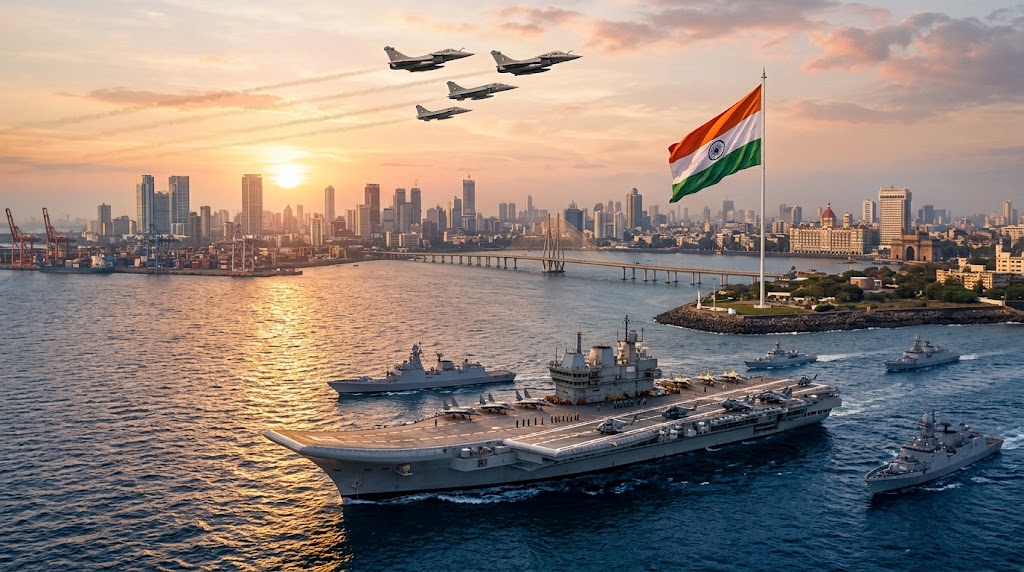
When we ask the question, how powerful is India, it's easy to get lost in a sea of numbers: millions of soldiers, billions of dollars, and a massive arsenal of fighter jets and missiles. There is no denying that India has firmly established itself as a major global power.
But true national strength is about much more than just hardware. It's about a booming economy, cutting-edge space programs, strategic global influence, and the ability to defend borders in some of the world's harshest environments. At the same time, this power comes with its own set of very real challenges, from economic inequality to a reliance on imported technology.
So, how strong is India, really? Let's look beyond the headlines to unpack India's military strength in 2026, its economic engine, its nuclear capabilities, and where it truly stands on the global chessboard against rivals like China and Pakistan.
The making of a global heavyweight
India is no longer just a rising power; it has arrived. With one of the world's largest populations, a rapidly expanding tech sector, and a formidable military, India plays a critical role in shaping international politics.
To put things in perspective, the Indian economy reached a nominal GDP of approximately $3.96 trillion in 2025, according to World Bank data. When you combine this financial muscle with being a top-five global military spender, you get a country that demands attention.
India's core pillars of strength include:
- A massive, battle-hardened military force
- Advanced nuclear weapons and missile technology
- A powerhouse IT and space sector
- A vibrant domestic market driven by a young demographic
- Strategic alliances with both Western and Eastern powers
But even giants have their vulnerabilities. To truly understand India's position, we have to weigh these impressive capabilities against its ongoing limitations.
The backbone of defense: India's military strength in 2026
When evaluating India's military strength in 2026, the sheer scale is striking. India has one of the largest armed forces on the planet, supported by complex missile systems and a robust intelligence network.
According to the Stockholm International Peace Research Institute (SIPRI), India's defense spending hit an estimated $92.1 billion in 2025, an 8.9% increase that made it the world's fifth-largest military spender. This massive budget allows the country to maintain its troop levels while continuously investing in next-generation defense technologies.
However, money doesn't automatically win wars. The true effectiveness of the Indian military lies in its experience. Indian troops are trained to operate across wildly diverse terrains, from the scorching deserts of Rajasthan to the freezing, thin-air peaks of the Himalayas.
Boots on the ground: Indian Army power
The foundation of India's defense is the Army, recognized globally not just for its size, but for its unmatched adaptability.
Along the volatile Himalayan frontiers, Indian soldiers face extreme altitudes, sub-zero temperatures, and treacherous supply routes. To maintain dominance here, India has heavily modernized its artillery, surveillance drones, and air defense systems.
Currently, a major push is underway to manufacture more of this gear domestically. While modernizing a force of this size is a slow, expensive process, the shift toward self-reliance is making the Indian Army a more independent and resilient force.
Ruling the skies: Indian Air Force
The Indian Air Force (IAF) is central to India's strategic planning. Operating a diverse fleet that includes French Rafales, Russian Su-30MKIs, and the home-grown Tejas fighters, the IAF is equipped for both air-to-air combat and precision ground attacks.
But managing the skies isn't without its challenges. Because India buys aircraft from various countries, maintaining different systems, integrating weapons, and managing spare parts can be a logistical headache.
Recognizing this, India is investing heavily in the future. In early 2026, major modernization plans were approved to add more Rafale jets and Boeing P-8I reconnaissance aircraft to the fleet, aiming to keep the IAF a dominant force in Asian skies.
Guardians of the ocean: Indian Navy strength
Look at a map, and you'll immediately see why Indian Navy strength is so critical. India sits at the heart of the Indian Ocean, a corridor for global trade and energy supplies.
Armed with aircraft carriers, stealth destroyers, and nuclear-powered submarines, the Indian Navy is designed to project power far beyond its shores. Whether deterring threats, conducting anti-piracy missions, or running disaster relief operations, the Navy is one of India's main tools for regional influence.
As China expands its own naval presence in the Indo-Pacific, India's continued investment in modern warships and maritime surveillance aims to keep it the primary security provider in its own backyard.
The ultimate deterrent: India's nuclear weapons
You can't discuss global power without talking about nuclear capabilities. India's nuclear arsenal serves as its ultimate strategic deterrent.
Having conducted its first test in 1974, India has spent decades refining its delivery systems. According to SIPRI's 2026 Yearbook, India commands an arsenal of roughly 190 nuclear warheads, deployable via land-based ballistic missiles, submarines, and aircraft. Notably, SIPRI reported that 2025 marked the first time part of India's arsenal was described as operationally deployed (12 warheads) rather than entirely held in reserve, a shift in how the force is maintained.
These weapons aren't meant for fighting conventional wars; their primary job is deterrence, sending a clear message that a large-scale attack would carry catastrophic consequences. Given that India shares borders with two other nuclear-armed nations, China and Pakistan, this arsenal requires immense responsibility, restraint, and careful crisis management.
Reaching for the stars: space and missile technology
Modern power isn't just about what you have on the ground; it's about what you have in orbit. India has made significant strides in space and missile technology.
Working alongside Russia, India developed the BrahMos cruise missile, and independently built the Agni series of nuclear-capable ballistic missiles, with SIPRI noting that a longer-range Agni-V variant could shift the existing nuclear balance between China, India and Pakistan.
Beyond weapons, the Indian Space Research Organisation (ISRO) has built a strong reputation with successful lunar missions. Satellites in orbit provide the military with real-time data, secure communications, and surveillance, reinforcing India's position as a serious technological player.
The financial engine: the Indian economy
A world-class military is only as strong as the economy funding it. The Indian economy is one of the country's greatest assets. With a $3.96 trillion GDP in 2025, it acts as a major engine driving domestic growth, IT dominance, and global trade.
But numbers can be deceiving. While the overall economy is massive, GDP per capita sat at just $2,702 in 2025. This highlights a stark reality: India is a wealthy nation in aggregate terms, but many of its citizens still face poverty, limited infrastructure, and income inequality.
Turning this raw economic size into higher living standards for over a billion people remains the real test of India's future strength.
India vs China: the bigger strategic rivalry
When analyzing Asian geopolitics, China is India's most significant long-term strategic competitor.
The numbers show a clear gap: in 2025, China spent an estimated $336 billion on its military, more than three-and-a-half times India's $92.1 billion budget, marking China's 31st consecutive year of rising military spending. China also has a massive industrial base capable of producing advanced ships, planes, and missiles at a rapid pace.
However, India holds its own advantages. India's strategic position in the Indian Ocean, its experienced troops, and its deepening partnerships with the US, Japan, and Australia (the Quad) help balance the equation. It isn't just a numbers game, geography, alliances, and strategy matter just as much as budget size.
India vs Pakistan: a long-standing rivalry
The historical tension between New Delhi and Islamabad keeps the India-Pakistan military comparison a subject of global interest.
On paper, India holds a substantial advantage. India's $92.1 billion defense budget dwarfs Pakistan's $11.9 billion (2025 SIPRI data, an 11% year-on-year increase). India also has a far larger economy and industrial base.
Yet in a real-world scenario, absolute size doesn't guarantee a swift outcome. Pakistan maintains a professional military, nuclear weapons, and capable missile systems. The short physical distance between the two countries means any conflict could escalate quickly, as seen during the May 2025 India-Pakistan military crisis, which involved aircraft, drones, missiles, and cyber operations on both sides. For both nations, maintaining deterrence and avoiding full-scale war remains far more valuable than engaging in direct conflict.
The global chessboard: diplomacy and influence
A major power needs partners, and India has built a reputation for strategic diplomacy, balancing relationships with the United States, Russia, the EU, and the Global South with notable agility.
By participating in groups like the G20, BRICS, and the Quad, India ensures it has a seat at most major tables. Its large consumer market, booming IT sector, and global diaspora make it an important partner for much of the world.
Where India still struggles
Despite its rapid rise, India has real hurdles to clear before claiming true superpower status:
- Foreign tech dependence: while the "Make in India" initiative is growing, the military still relies heavily on foreign suppliers for critical components, creating potential supply chain risks
- Economic inequality: national power is limited when a large share of the population lacks access to quality healthcare, education, and well-paying jobs
- Two-front tensions: managing active, heavily militarized borders with both China and Pakistan draws resources that could otherwise go toward development
Can India become the world's most powerful country?
The short answer: it has most of the right ingredients. India has the demographic advantage, economic momentum, technological talent, and military capability needed to play a leading role in the 21st century. But potential alone isn't enough. India's long-term success will depend on how it manages its internal economic divides, nurtures domestic innovation, and navigates the complex geopolitics of Asia.
India's true strength won't just be measured by the conflicts it can deter, but by the stable, prosperous society it can build at home.
Frequently asked questions
Is India a powerful country?
Yes. India is a major global power, marked by a large military, nuclear capabilities, a booming tech sector, and significant diplomatic influence on the world stage.
How much does India spend on its military?
According to SIPRI, India's military expenditure was estimated at $92.1 billion in 2025, making it the world's fifth-largest military spender.
How many nuclear weapons does India have?
As of the SIPRI 2026 Yearbook, India is estimated to have around 190 nuclear warheads, serving as a key strategic deterrent.
Is India stronger than Pakistan?
In terms of defense budget and economy, India is far larger, spending roughly eight times more than Pakistan's $11.9 billion in 2025. However, since both nations have nuclear weapons and capable armed forces, a direct conflict would be unpredictable and costly for both sides.
Is China stronger than India?
By spending alone, yes, China's $336 billion military budget is over three times India's. However, India counters this gap with strategic geography, experienced forces, and strong international alliances.
Editorial Note: The military spending and nuclear arsenal figures in this article are based on estimates published by SIPRI, while economic figures rely on World Bank data for 2025/2026.