
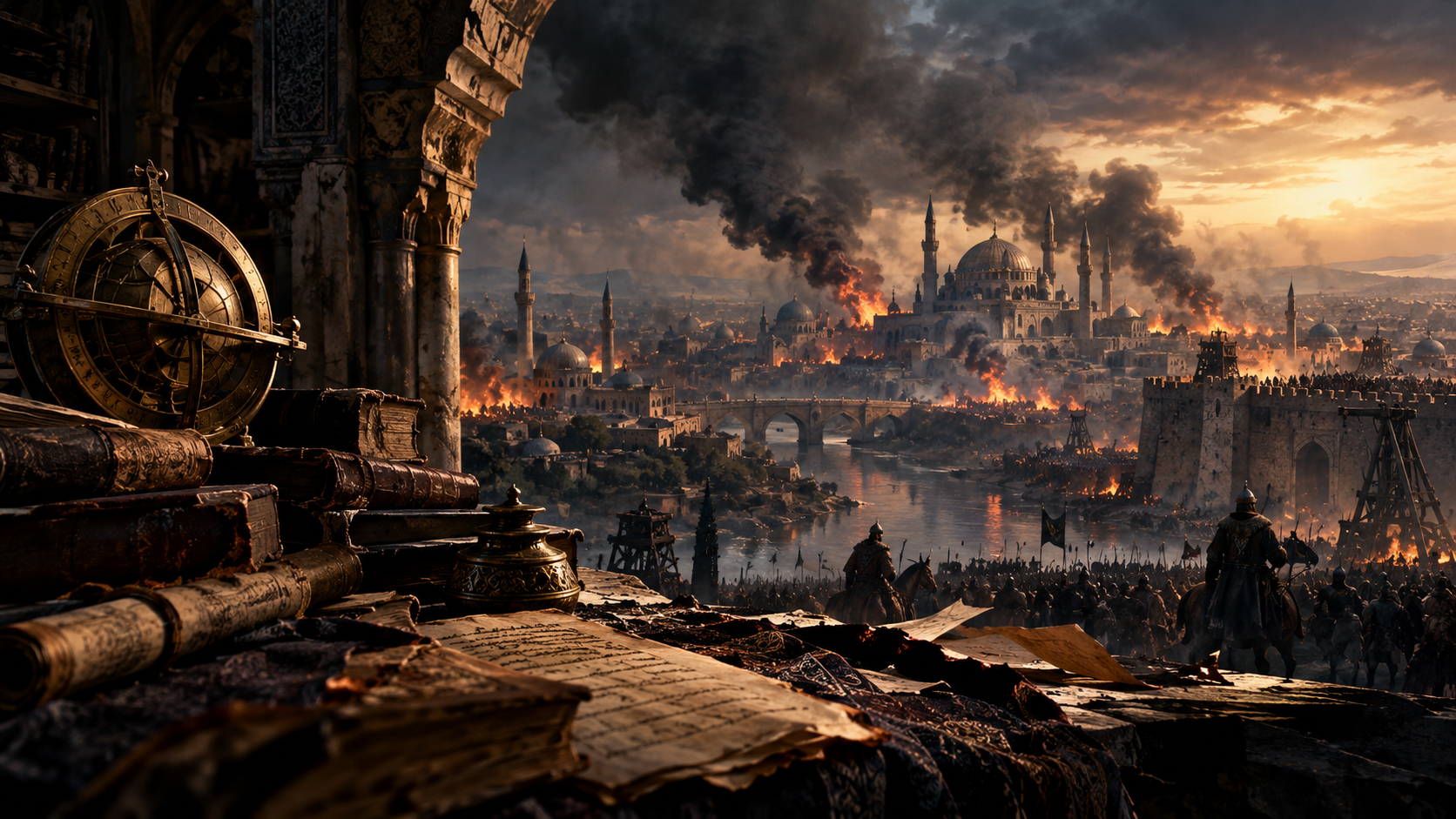
When Muslims were at the height of their civilization, Baghdad was as famous worldwide for learning as the West is today for higher education. Seekers of knowledge from across the world made their way to Baghdad, home to the greatest center of learning on Earth: the House of Wisdom, or Bayt al-Hikma. This great institution was founded by the Abbasid Caliph Harun al-Rashid, and later raised to its peak by his son, al-Ma'mun.
Here, rare texts in Greek, Persian, and Indian languages were translated into Arabic — widely considered the House of Wisdom's greatest achievement. If this institution had not carried out that historic work, the world today might not even know philosophers like Socrates, Aristotle, and Plato, since their original writings had been burned during Europe's wars and Dark Ages.
It is a strange thought: while all of Europe burned in fire and ignorance, Muslims sat in the halls of the House of Wisdom translating books from across the world, raising scholarly questions, and seeking their answers through experimentation. The most beautiful thing about the House of Wisdom was that its doors were open to people of every faith — Muslim, Christian, and Jewish scholars worked side by side under one roof, uncovering the secrets of the universe together.
The Background of the Attack and Hulagu Khan's Ambitions
The wheel of history turned, and in 1253 the Mongol ruler Möngke Khan sent his brother Hulagu Khan toward the Middle East with a massive army and two clear orders: first, to destroy the Ismaili fortresses in Iran, and second, to bring Baghdad's ruler — al-Musta'sim Billah, the 37th and final Abbasid Caliph — to submit before the Mongol Empire, and if he refused, to wipe Baghdad off the map entirely.
Before attacking Iran, Hulagu Khan had requested troops from the Abbasid Caliph to fight alongside the Mongols, but Caliph al-Musta'sim flatly refused. Hulagu Khan took this refusal as open rebellion. There was also a deeper reason: the Mongols believed that as long as the Abbasid Caliph sat in Baghdad, Muslims around the world could unite against the Mongols at any moment in the name of their spiritual center. To subdue the Muslims, then, it was first necessary to destroy their center — Baghdad and the Abbasid Caliphate itself.
The Internal State of Muslims at the Time of the Attack
By this point, the Muslim world was fractured. The Mamluk and Ayyubid sultanates stood separately in Egypt and Syria, while the Abbasid Caliph's rule had shrunk to Baghdad and a handful of surrounding areas. On top of that, the Caliph had drastically cut troop numbers in order to fill the royal treasury. By some estimates, the Abbasid state had only 10,000 to 20,000 soldiers available to defend Baghdad.
Though militarily weak, Baghdad remained the center of learning. The House of Wisdom's fame had spread across the world, and scholars from everywhere came to conduct research there. Besides the House of Wisdom, Baghdad was home to 36 major public libraries — including the Mustansiriya Madrasa and the Nizamiyya University — holding millions of rare handwritten manuscripts, gathered over 500 years of effort.
The War of Letters and the 13-Day Bloody Siege (January–February 1258)
In late 1257, before launching his attack, Hulagu Khan sent a threatening letter to Caliph al-Musta'sim from the Iranian city of Hamadan:
"Tear down your city's walls, fill in its moats, and come to my court yourself. If you do not, when I descend upon Baghdad like a raging storm, you will find refuge neither in the heavens nor on earth."
Caliph al-Musta'sim still believed Baghdad was invincible. He wrote back to Hulagu: "Foolish young man! Do you not know that from east to west, all Muslims are my servants? If I give a single signal, the whole world will rise against you." But the reality was that the Caliph had neither sought help from neighboring Muslim rulers nor repaired Baghdad's walls.
In January 1258, Hulagu Khan advanced on Baghdad with a force of 150,000. Alongside the Mongols marched Christian contingents from Georgia and Armenia, as well as a thousand Chinese catapult and gunpowder experts. Hulagu encircled the city from both banks of the Tigris River. On January 17, 1258, the Caliph sent 20,000 soldiers under commanders Sulayman Shah and Aybak to stop the Mongols — but the Mongol commander Baiju broke the dikes along the Euphrates canals at night. The Abbasid army's camp was suddenly flooded; thousands of soldiers drowned, and the Mongols cut down the rest.
On January 29, 1258, Hulagu Khan's forces surrounded Baghdad on all sides. In a single day and night, the Mongols dug a deep trench and built a large wooden palisade around the city so that not a single person could escape. From January 30 to February 4, Chinese engineers bombarded the city's weakened wall and the "Ajami Tower" with catapults hurling heavy stones and naphtha fireballs. When stones ran out, the Mongols cut down date palms and tore bricks from outlying buildings to keep up the bombardment — until, on February 5, the Ajami Tower collapsed and Mongol soldiers scaled the wall.
The Attempt at Peace, Betrayal, and the "Seven Days of Doom"
Once the wall fell, the panicked Caliph sent his vizier, Ibn al-Alqami, with gifts to negotiate peace. Hulagu set a condition: the Caliph, along with his three sons, his vizier, and all his military commanders, had to surrender and come out themselves. When 3,000 senior officials, judges, and commanders of Baghdad came out hoping for peace, Hulagu broke his word and had them all killed on the spot.
With no options left, Caliph al-Musta'sim surrendered on February 10, 1258. Hulagu then had the Caliph order the city's residents to lay down their weapons and gather in the open fields outside the city so they could be counted. The moment Baghdad's unarmed citizens stepped into the open, Mongol soldiers surrounded and slaughtered them.
From February 13 to 20, Hulagu Khan allowed his army seven days of open looting and massacre across Baghdad. People hid in mosques, seminaries, and basements, but doors were broken down and everyone was dragged out. The historian Abdullah Wassaf wrote that blood ran through the streets the way rainwater runs through gutters.
During that same week, the House of Wisdom and all 36 libraries were burned to ashes. Mongol soldiers tore the leather bindings off books to make shoes, and threw the remaining millions of books into the Tigris River — turning the water black with ink and red with the blood of scholars. (Only the famous scholar Nasir al-Din al-Tusi managed to get Hulagu's permission to save a few hundred thousand books for the Maragha Observatory; otherwise, almost everything was destroyed.)
On February 20, 1258, Caliph al-Musta'sim was wrapped in a thick carpet and trampled to death under horses' hooves, so that — according to Mongol belief — royal blood would not touch the ground. On February 21, with the stench of corpses and the risk of plague spreading through the city, Hulagu Khan moved his camp outside Baghdad.
What Muslims Did After the Attack, and What Was Lost
When Baghdad fell, a stunned silence spread across the Islamic world — for the first time in 500 years, the world had no caliph. Yet within just two years, two major events unfolded:
The Battle of Ain Jalut (1260): As Hulagu Khan's army swept through Syria toward Egypt, the Mamluk ruler of Egypt, Sultan Sayf al-Din Qutuz, and his commander Rukn al-Din Baybars refused to back down. They met the Mongols at Ain Jalut in Palestine. For the first time in history, a Mongol army suffered an outright defeat, and Hulagu's commander Kitbuqa was killed.
Berke Khan's Revenge: Genghis Khan's grandson and Hulagu's cousin, Berke Khan — who had converted to Islam — was devastated by the destruction of Baghdad. He declared: "Hulagu has destroyed the cities of the Muslims and killed the Caliph without consultation. I will account for this bloodshed." Berke Khan allied with the Mamluks and waged war against Hulagu Khan, a conflict that meant Hulagu could never again turn toward Mecca, Medina, or Egypt.
Historians regard 1258 as marking the end of the Islamic Golden Age. Had this attack never happened, what exactly did Muslims lose that they might otherwise have kept?
500 years of scientific research, gone: This was an age before the printing press; each book existed as only one or two handwritten copies. With the House of Wisdom destroyed, more than 90 percent of the era's books on astronomy, medicine, mathematics, chemistry, and history vanished forever.
A scientific revolution, delayed: Had Baghdad survived, the scientific method pioneered by figures like al-Khwarizmi, Ibn al-Haytham, and al-Biruni might have carried the industrial and scientific revolution that eventually reached 18th-century Europe to the Muslim world some 300 years earlier.
From discovery to preservation: After this trauma, Muslim scholars' focus shifted away from new innovation and toward preserving what little knowledge remained, as a climate of fear pulled general thought away from experimentation.
Historical Sources and References
- Ibn Kathir — Al-Bidaya wa'l-Nihaya (The Beginning and the End), Vol. 13: Account of the Year 656 AH (1258 CE)
https://archive.org/details/AlBidayaWalNihayaIbnKathir - Rashid al-Din Hamadani — Jami' al-Tawarikh (Compendium of Chronicles): History of the Mongols and Hulagu Khan's Campaign
https://www.britannica.com/topic/Jami-al-tawarikh - Jim Al-Khalili — The House of Wisdom: How Arabic Science Saved Ancient Knowledge and Gave Us the Renaissance
https://www.worldhistory.org/House_of_Wisdom/ - Encyclopaedia Britannica — Siege of Baghdad (1258) & The Fall of the Abbasid Caliphate
https://www.britannica.com/event/Siege-of-Baghdad - Firas Alkhateeb — Lost Islamic History: Reclaiming Muslim Civilisation from the Past
https://archive.org/details/LostIslamicHistory