
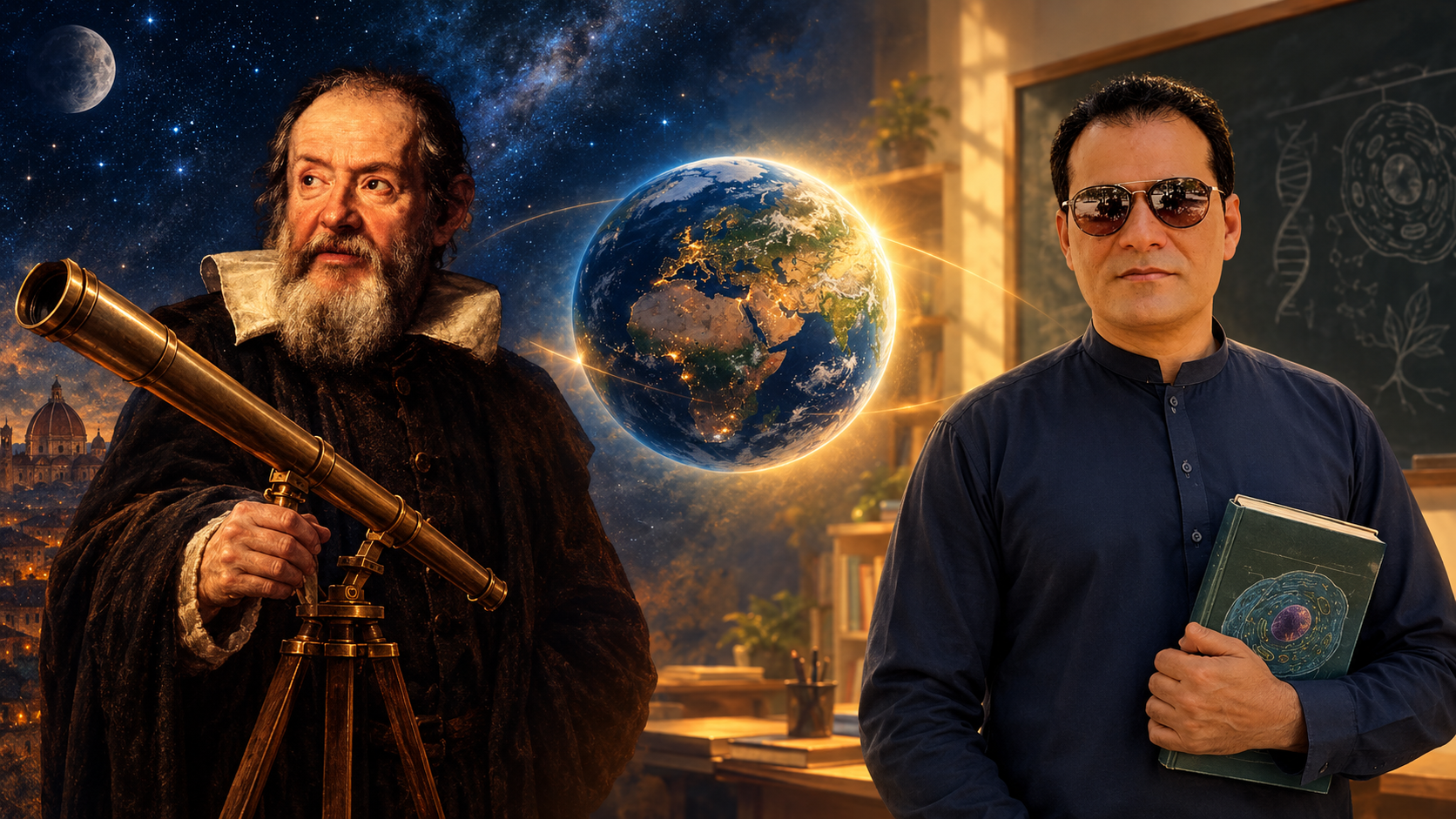
In 1633, in Rome, a 70-year-old scientist was forced to retract his own words. Almost 400 years later, in 2023, something similar happened to a professor in Bannu. Between them lie centuries, thousands of miles, and completely different languages, dress, and customs. Yet why do people mention these two names together?
Let me make one thing clear first: this piece will not enter the debate about which scientific theory is right and which is wrong. It is only about what happened to both men, and what it is in those events that links their names together.
An Old Man, a Telescope, and a Claim That Could Not Be Tolerated at the Time
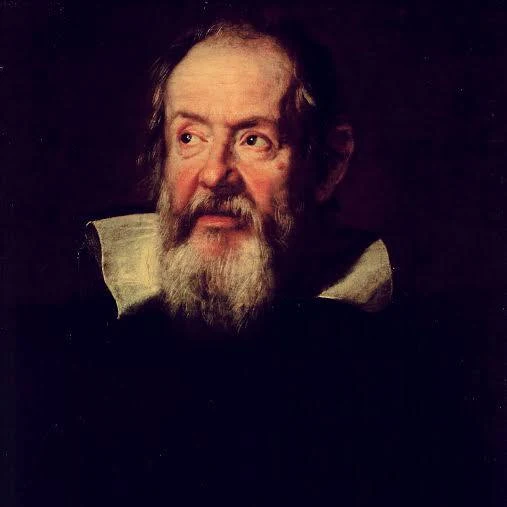
Galileo Galilei was a famous Italian scientist, an expert in astronomy, physics, and mathematics. He is counted among the founders of modern science. He was born on 15 February 1564 in Pisa, and died on 8 January 1642 at the age of 77 in Arcetri, near Florence.
He had started out studying medicine, then moved toward mathematics and science. Through the telescope he saw with his own eyes what had previously existed in books only as speculation: the moons of Jupiter, the phases of Venus, the mountains of the Moon.
On the basis of those observations, and of Copernicus's theory, he said that the Earth revolves around the Sun. The Christian Church's interpretation at the time was that the Earth was stationary and the Sun revolved around it, so Galileo's view was seen as contrary to religious interpretation.
In 1632 he published his famous book arguing in favour of this theory. The Church had already warned him before that. In 1633 he had to appear before the Inquisition in Rome. He was about 70 years old at the time.
In reality, there was no third way open to him. Either he gave up his observations, or he suffered severe punishment. This fear was not imaginary. Just a few years earlier, Giordano Bruno had been burned alive. Galileo knelt down and admitted in writing that his theory was wrong, that the Church's interpretation was correct, that the Earth was stationary and the Sun revolved around it. He spent the rest of his life under house arrest.
It is said that as he left the court, he whispered, "Eppur si muove", meaning "And yet it moves". Galileo probably meant that despite his own denial, and the Church's denial, reality could not be changed.
The Teacher From Bannu Who Is Popular Among Young People
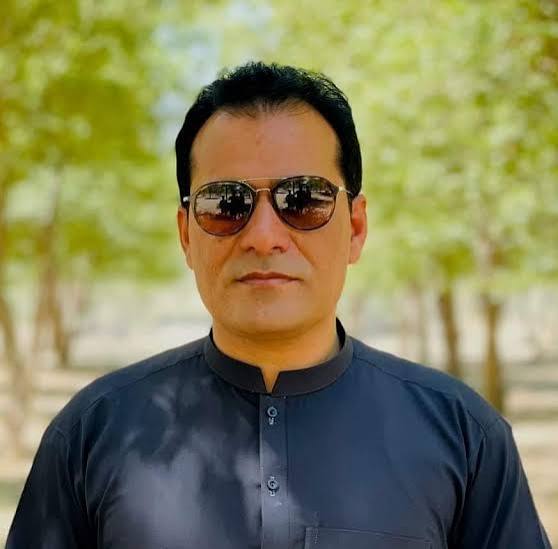
Professor Sher Ali is an assistant professor at the Government Postgraduate Degree College, Bannu, in Khyber Pakhtunkhwa. He did his MSc in Zoology from Peshawar University and his MPhil in human genetics from Quaid-i-Azam University, Islamabad. He comes from a village in Domail.
What happened to him was not the story of a single day. His disagreement with local scholars first began over Darwin's theory, and then over women's rights. During this same disagreement, on 19 May 2022, on his way home from college, a bomb planted in his car exploded. He had already been receiving threatening letters. He survived, but lost a leg. Even in that condition, his spirit did not break. According to a person who went to interview him in those days, he gave the example of Stephen Hawking, whose body was almost lifeless yet who kept changing the world, and asked why he himself should lose hope. More than four years have passed, and he is still active and healthy today.
Then came October 2023. On 5 October 2023, at a seminar in the college, he spoke about women's rights in the light of the Constitution. After that, local scholars became angry. They also objected that he taught the theory of evolution, which is included in the curriculum.
Professor Sher Ali's position was simple. He is a Muslim, but as a teacher, his duty is to teach what is in the curriculum prepared by the government, and he did not prepare that curriculum himself.
The matter was then settled in the office of the Deputy Commissioner, Bannu, in the presence of the scholars. There, an 11-point affidavit was taken from him, including dissociation from all theories contrary to Sharia. The administration's justification was that law and order in the area could deteriorate. After that, Professor Sher Ali stopped speaking to the media.
Two Different Eras, the Same Pattern
Look closely, and the similarity is not in a single point, but in the whole pattern. Galileo stood on his observations, Professor Sher Ali stood on the official curriculum. Neither had invented a personal theory to present; both said only what was part of their knowledge or their duty.
Galileo faced the religious authority of his time, Professor Sher Ali faced the influence of local scholars. Galileo had to appear before the Inquisition, Professor Sher Ali before the scholars in the Deputy Commissioner's office. In both places there was one strange thing in common: the accuser and the one deciding the case were on the same side. And the outcome was similar too: they had to withdraw their words in writing, and after that, silence fell.
That is why, when people mention Professor Sher Ali's case, they call him "Pakistan's Galileo". In 2024, the UK journal Free Thinker published his interview under that very title.
The Two Cases at a Glance
| Aspect | Galileo | Professor Sher Ali |
|---|---|---|
| Time and place | 1633, Rome | 2023, Bannu |
| What he stood on | Telescope observations and Copernicus's theory | The government-prepared curriculum |
| Who he faced | The religious authority of his time (the Inquisition) | Local scholars |
| Where he had to appear | The Inquisition in Rome | The Deputy Commissioner's office |
| Outcome | Retracted in writing, spent the rest of his life under house arrest | Signed an 11-point affidavit, then stopped speaking to the media |
But Hiding the Differences Would Not Be Honest Either
It would not be correct to say that the two incidents were exactly the same. Galileo faced a formal trial, whereas Professor Sher Ali's case was settled in an administrative meeting. On the other hand, a lethal attack had also been carried out on Professor Sher Ali, something that did not happen to Galileo. So instead of saying "exactly the same incident", it is more accurate to say that this incident recalls Galileo.
The Earth Is Still Moving
Galileo's signature did not stop the Earth from moving, and his silence did not end his question. Today the world remembers him not as a criminal, but as a man who was wronged. In 1992, Pope John Paul II himself admitted that mistakes had been made in Galileo's case.
Disagreement exists in every society and will continue to exist, but its answer should come through argument, dialogue, and the law, not through pressure and a written apology.
Frequently Asked Questions
Why is Professor Sher Ali called "Pakistan's Galileo"?
Because both men, despite standing on their knowledge or their duty, had to withdraw their words in writing under pressure from religious influence. In 2024, the UK journal Free Thinker published his interview under that title.
What happened to Galileo in 1633?
He had to appear before the Inquisition in Rome, where he admitted in writing that his theory was wrong. He spent the rest of his life under house arrest.
What happened to Professor Sher Ali?
On 19 May 2022, a bomb in his car exploded and he lost a leg. In October 2023, after a seminar and objections from local scholars, an 11-point affidavit was taken from him in the Deputy Commissioner's office in Bannu.
Are the two cases exactly the same?
No. Galileo faced a formal trial, while Professor Sher Ali's case was settled in an administrative meeting, and he also survived a lethal attack that Galileo never faced. It is more accurate to say his case recalls Galileo's.