
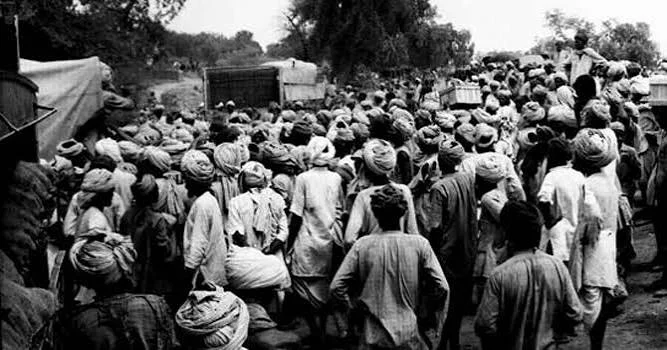
The advent of independence on August 15, 1947 simultaneously saw the division of the Indian sub-continent into two countries India and Pakistan. The province most affected by Partition was Punjab which was caught in unprecedented collective violence. In only three months, between August and October 1947, the land of five rivers, was engulfed in a civil war. Attacks by the Muslims in the West Punjab were followed by counter-attacks by the Sikhs and the Hindus in the East Punjab. The communal venom that had seeped into the minds of all the communities, got expression in large-scale arson, murder of innocent men, women and children, looting, forcible conversions and abduction of women.¹
This was a time when the hurricane of communal passions swept the whole Punjab community clan of all decency, morality and sense of human values.² The focus in this paper has been on killing in the trains during the Partition of Punjab in 1947.
The most immediate impact of the Partition was the brutal and gruesome violence which it brought. Nobody knows how many people were killed in Punjab during the Partition riots. The estimates of persons killed in Partition violence differed widely. It is, of course, undeniable that virtually all sections of Punjabi society could count among their kinsmen those who were uprooted, plundered, assaulted and murdered.
From early 1947 Punjab had gradually been succumbing to communal violence which became more brutal and widespread after March 4. In the last days of the British Raj, it was not only the case that violence occurred as a consequence of partition, but 'violence was a principal mechanism for creating the conditions for partition'.³ The violence which preceded Partition was grave, widespread and lethal. After 15 August 1947, it took on a new ferocity, intensity and callousness. Now militia trawled the countryside for poorly protected villages to raid and raze to the ground, gangs deliberately derailed trains, massacring their passengers one by one or setting the carriages ablaze with petrol. Women and children were carried away like looted chattels.⁴
The Partition of Punjab in 1947 was followed by the forced uprooting of more than twelve million people belonging to minorities who sought shelter across the newly created boundaries in the two states of India and Pakistan. The minorities were made to quit their hearths and homes in the most adverse circumstances created by communal riots and they had to reach the country of their destination very often as paupers.
Mohammad Waseem has described the migration in connection with the Partition of Punjab as 'one of the most violent processes of ethnic cleansing in recent history'.⁵ The growing uncertainty about the future course of events, such as the drawing of boundary lines and the possible extent of communal violence, proved cataclysmic in terms of making people move away to perceived safer areas where their community was in majority.⁶ While some people were forced to move because of fear of death, others sought to escape shame and humiliation brought about by the abduction of women, rape, and forcible conversions.⁷
Once the Boundary Line became clear, the numbers of refugees crossing Punjab and moving out of the state intensified frighteningly quickly. Between August and November 1947 - a bare three months - as many as 673 refugee trains moved approximately 2,800,000 refugees within India and across the border.⁸
Partition refugees did move in other ways on foot, columns or kafilas also by trucks and cars. But it is the railway compartments with people clambering dangerously on train tops that have provided the totemic image of Partition migration.
Partition narratives - official, semi-official and survivors' testimonies suggest that there was a big difference in the way that people left. The refugees marched across the border on foot, bullock carts, trains, in any means of transport they could find. The rural refugees with their farming essentials and meagre belongings, started their journeys either on foot or in bullock carts. The trains were deployed to ferry the urban refugees.
While the foot journeys took weeks of travel and were fraught with dangers of violent attacks, looting and abduction of women and children. The train journeys were much in demand as a quick means to get away from risk-zones even though these were also fraught with danger. The ambushes and killings in trains and at various railway stations in Punjab make the communal massacres difficult to forget or ignore. The railway station and compartment of the train became the 'indicators of the misery of refugee existence - a life in flux.'⁹
Overcrowded trains provide the most enduring images of Partition. No image of Partition, textual or in the mind's eye, photograph or film, escapes from the overloaded trains with men, women and children moving from one side of the border to the other.¹⁰ Due to their central role as a preferred means of urban evacuation, they have become symbolic of the last journey of the masses.
In the opening scenes of Khushwant Singh's novel, Trains to Pakistan, a train inhumanly crammed with refugees passes through Punjabi countryside near the Indo-Pak border. 'Like all the trains, it was full. From the roof, legs dangled down the sides on to the doors and windows. The doors and windows were jammed with heads and arms. There were people on buffers between the bogies.'¹¹
The narratives of Partition are full of gory accounts of train loads of dead passengers arriving on railway stations. The images of trains carrying dead passengers have become a symbol of pain and trauma that ordinary people went through.
In fact, sending train loads of dead passengers across the borders became a mad competition on both sides of the border so that each exhorted its community to kill even greater number of people to be sent across to the other community.
As in Train to Pakistan:
'One morning, a train from Pakistan halted at Mano Majra railway station. At first glance, it had the look of a train in the days of peace. No one sat on the roofs. No one clung between the bogies. No one was balanced on the footboards. But somehow it was different. There was something uneasy about it. It had a ghostly quality ... The arrival of the ghost train in broad daylight created a commotion in Mano Majra.'¹²
There were very serious attacks on trains in Punjab between August 1947 and the spring of the following year. Leonard Mosley gave a graphic account of the violent incidents that took place during this period. He writes:
"It was a time when trains were arriving in Lahore station packed with passengers, all of them dead, with messages scribed on the sides of the carriages reading: 'A present from India' so, of course, the Muslims sent back trainloads of butchered Sikhs and Hindus with the message: 'A present from Pakistan' .... All India stank - with the stench of countless thousands of dead bodies, with the stench of evil deed, with the stench of fires."¹³
Wolpert also writes: In and around Amritsar, bands of armed Sikhs killed every Muslim they could find, while in Lahore, Muslim gangs - of them 'police' - sharpened their knives and emptied their guns at Hindus and Sikhs. Entire trainloads of refugees were gutted and turned into rolling coffins, funeral pyres on wheels, food for bloated vultures who darkened over the Punjab and were stated with more flesh and blood in those final weeks of August than their ancestors had enjoyed in a century."¹⁴
The refugee trains were known as 'India Specials' or 'Pakistan Specials.' The special trains were frequently subjected to sabotage by ingenious methods, in order to way lay them and then massacre the refugees.
The most deadly attacks were those against these Refugee Special trains. These were highly organized affairs in which ex-military personnel, with knowledge of explosives and sabotage techniques, played a prominent role. Most trains carried on average three to four thousand refugees, and were accompanied by small military escorts, which were often incapable of preventing considerable loss of life.
A massacre in these trains left two to three thousand passengers killed and the rest injured. These trains served purpose for the marauding gangs as they could indulge in 'wholesale slaughter' because these trains carried the members of a single community.¹⁵
Swarna Aiyar gives details of the massacres that occurred on trains in the Punjab in 1947 and also discusses the planning involved and methods employed in these killings. She writes:
"Sikhs on railway platforms would observe Muslims entraining, and enter the same carriages. After the train's departure, they would single out the Muslims and push them out of the windows, at pre-decided spots, like rail side telegraph poles that were marked with a white flag. There gangs of killers waited to complete the killings. Often the gangs conducting this had their couriers on trains who pulled the communication cord between stations, and the killer gangs then operated throughout the train..... The attacks were organized with military precision, with one half of the gang providing covering fire while the others entered the train to kill."¹⁶
The trains were especially vulnerable to systematic, premeditated attacks because trains have fixed routes and may not change them and that indeed their times of arrival and departure were known to the attackers.
Trains would usually be attacked when passing through the countryside, which provided ideal cover for the mobs stopping the trains, as they could lie in wait in the nearby fields of standing crops of sugarcane or maize, and vanish with equal ease once the looting and killing were completed. For the same reasons attacks were generally carried out at night or in the early hours of the morning.¹⁷
The methodical and systematic manner in which these killings and train attacks took place, point to a high degree of planning and organization. Many accounts reveal that the attacks in both sides of Punjab were carried out with military precision.
The observations of Francis Tuker, who was the Commander in this regard are worth mentioning.¹⁸ The systematic organization and the high degree of planning that was involved in the sabotage and stoppage of trains suggests at least some degree of complicity by officials, among the staff of the civil administration generally, an the railway staff in particualr.¹⁹
The tragedies of Partition would not have been complete had they not been accompanied, as every conflict since the dawn of history, by an outpouring of sexual savagery.²⁰ Tens of thousands of girls and women were seized from refugee columns, from crowded trains, from isolated villages, in the most wide-scale kidnapping of modern times.²¹
While men belonging to the other community were killed in the trains women were not let off in show of compassion instead they were abducted. Partition accounts refer to sexual molestation and abduction of women in refugee trains.²²
In Lahore retaliation from the Muslims was swift. The Lahore Railway Station became a veritable death-trap between August 12 and August 18. The riots in the city compelled the non-Muslims to leave, and their only avenue of escape was the railway station, because journey by road was far more perilous ...
There was a general state of tension and anxiety and when news came that the Sind Express, on its way to Lahore, had been attacked by Muslims, the panic spread among the passengers.... The next day, it became impossible for non-Muslims even to reach the railway station. They were caught and massacred on the way .... On August 14 and 15 the railway station became a scene of wholesale carnage.²³
The incidents of retaliation were especially prominent in cases of train attacks. Whenever a 'ghost train' laden with dead bodies arrived on one side, another would immediately be sent in the opposite direction.²⁴
Prakash Tandon, a Hindu Punjabi from Gujarat, in his personal account writes:
' ... train crammed with two thousand refugees came from the more predominantly Muslim areas of Jhelum and beyond. At Gujarat station the train was stopped, and Muslims from the neighbourhood, excited by the news of violence in East Punjab, begad to attack and loot. There was indescribable carnage. Several hours later the train moved on, filled with a bloody mess of corpses, without a soul alive. At Amritsar, when train with its load of dead arrived, they took revenge on a train load of Muslim refugees.'²⁵
Fictional and non-fictional accounts of Partition point out that the train administration on both sides was not only sabotaged by fanatics but the railway staff itself was divided along communal lines so that the trains would not be allowed to leave the station until the passengers of the other faith were slaughtered, women abducted, belongings looted.
An inquiry report about a train accident, for instance, points to the complicity of the railway staff:
'.. a Muslim refugee special (train) which left Ambala met with a serios (serious) accident at Shambu railway station (Patiala state). Engine and three bogies derailed, resulting in 129 deaths and injuries to about 200 persons of whom nine died in the hospital.... Accident (occurred) due to the train having directed to a deadline instead of the mainline, which is attributed either to gross negligence of railway staff or a deep-seated conspiracy. The station ASM, pointsman and the driver have been arrested.'²⁶
D.A. Low points out that 'the human agonies which they (victims) suffered are, in the standard accounts, often buried away. Often they are neglected altogether.' ... The fictionalized narrative apparently furnishes a more bearable medium for explicit descriptions of unnerving horrors than raw accounts by victims and survivors can provide now.²⁷
Some important fictional works that have captured the horror, trepidation and fear of passenger travelling in trains to cross over the other side of the border are - Khushwant Singh's novel Train to Pakistan; Krishan short story "Peshawar Express"; Bhisham Sahni's story, "The Train Has Reached Amritsar" and Aziz Ahmad's "Kali Raat."²⁸
The train in fictional narratives on Partition has been used at multiple levels: as a narrator, as means of escape, as the site for killings, as a symbol of dislocation and deranged humanity.
Train to Pakistan provides a picture of Mano Majra, a village in Punjab, close to the newly formed border, in which trains play a vital part in the everyday life of the villagers, and subsequently, trains become the cause of turbulence in an otherwise calm and peaceful village.
As the number of refugees on the railway stations increased the condition of stations became awful and worse. The condition of Amritsar railway station in the middle of September was beyond description.
A British army officer writes about condition of evacuees on station:
'On their arrival in Amritsar their condition was beyond description. There were dead and dying in every rail truck, and their beddings were covered by bile and excreta. The smell was almost unbearable. It is said that approximately 100 women were abducted at the first derailment and several killed.
Police reports state that the train arrived in Jullundur 12th September evening with 145 dead, of which 100 had been killed and 45 had died for want of food and water. During the search by the police in Amritsar some 50 to 60 women and children died of thirst, hunger and sunstroke, as no efforts had been made to give these people water, although there was a plentiful supply in the station. No civil medical aid was available.'²⁹
This could be taken as representative of the conditions on railway stations in Punjab.
The people travelling in the trains shared the same hatred, mass hysteria and insecurity that characterized those travelling on foot columns.
In Bhisham Sahni's story, "The Train Has Reached Amritsar" the passengers are tense and nervous whenever the train stopped, 'the passengers watched each other suspiciously. If the train slowed down they started at each other apprehensively. If it stopped, the silence inside became unbearable.'³⁰
A British officer touring in Punjab gave description of the ordeal of train travel for refugees as he wrote:
'Some of the events such as murder, brutality, looting, ill treatment of women and small children in evacuee trains, the results of vicious hatred and communal fury, have outdone even Belsen and other bestialities created by the warped Nazi mind... in every carriage without exception the dead and dying were mixed up with the wounded - it was certainly a train of death. ...'³¹
Some accounts also point out that violence was not all encompassing. There were some acts of mercy and charity. Many persons saved the lives of neighbours, friends and strangers even by risking their own lives.
In Train to Pakistan, the attackers tied a thick steel wire on top of two poles across the railway track. But the plan to derail the train failed as the hero cuts the steel wire he falls on the tracks only to be crushed by the passing train which carries his beloved and their unborn child safely across the border.
There are some stories which provide compelling evidence of a counter-flow to the polarization of society in 1947. Even a future President of India, Zakir Hussain, owed his life to the intervention of a Sikh captain and Hindu railway employee who saved him from a gang at Ambala railway station.³²
However, these examples were by far out-numbered by instances where communal leaders actively engaged in aiding and abetting the violence.
The number of people killed in trains was far less than those killed on ground, but savage brutality with which train killings were executed are shocking examples of genocide and are the most powerful images of the communal holocaust of 1947.
About Author
Navdip Kaur
Author of “Violence and Migration: A Study of Killing in the Trains During the Partition of Punjab in 1947.”
Originally published in IHC: Proceedings, 72nd Session, 2011, p. 954. Publication details are reproduced as indicated in the supplied reference text.
References and Notes
1. Satya M. Rai, Partition of the Punjab, Delhi, 1965, p. 47.
2. Ibid., p. 257.
3. Paul R. Brass, Forms of Collective Violence, Gurgaon, 2006, p. 19.
4. Yasmin Khan, The Great Partition, New Delhi, 2007, p. 128.
5. Mohammed Wasim, “Partition, Migration and Assimilation: A Comparative Study of Pakistani Punjab,” UPS, Vol. 4, No. 1, 1997, p. 21.
6. Ravinder Kaur, “The Last Journey: Exploring Social Class in 1947 Partition Migration,” EPW, Vol. XLI, No. 22, June 3, 2006, p. 2222.
7. Ibid.
8. Government of India, Millions on the Move: The Aftermath of Partition, New Delhi, 1948, p. 5.
9. Ravikant and Tarun K. Saint (eds.), Translating Partition, New Delhi: Katha, 2001, p. xv.
10. The photographs are available at NMML, New Delhi, and are reproduced in many books on Partition. See the cover of Khushwant Singh's Train to Pakistan, New Delhi: Lotus Roli, 2006 (reprint of 1956); Yasmin Khan, op. cit.
11. Ibid., p. 64.
12. Ibid., pp. 120–121.
13. Leonard Mosley, The Last Days of the British Raj, New Delhi, 1961, p. 243.
14. Stanley Wolpert, Jinnah of Pakistan, New York, 2010 (reprint of 1984), p. 342.
15. Swarna Aiyar, “‘August Anarchy’: The Partition Massacres in Punjab 1947,” in D. A. Low and Howard Brasted (eds.), Freedom, Trauma, Continuities, New Delhi, 1998, pp. 20–23.
16. Ibid., p. 22.
17. Ibid.
18. Sir Francis Tuker, While Memory Serves, London, 1950, pp. 485–491.
19. Swarna Aiyar, op. cit., p. 23.
20. Larry Collins and Dominique Lapierre, Freedom at Midnight, New York, 1975, p. 392.
21. Ibid., p. 393.
22. G. D. Khosla, Stern Reckoning, New Delhi, 1989 (reprint of 1949), pp. 164–165; Sir Francis Tuker, op. cit., p. 480.
23. Ibid., p. 122.
24. Sir Francis Tuker, op. cit., p. 481.
25. Prakash Tandon, Punjabi Saga 1857–2000, New Delhi, 2000, p. 131.
26. Kirpal Singh (ed.), Select Documents on the Partition of Punjab 1947, New Delhi, 1991, p. 565.
27. D. A. Low, “Introduction,” in D. A. Low and Howard Brasted (eds.), op. cit., p. 7.
28. For Partition stories, see Alok Bhalla (ed.), Stories about the Partition of India, 3 vols., Delhi, 1994; Saros Cowasjee and K. S. Duggal (eds.), Orphans of the Storm: Stories on the Partition of India, New Delhi, 1995.
29. Sir Francis Tuker, op. cit., p. 481.
30. Bhisham Sahni, “The Train Has Reached Amritsar,” in Richard Allen and Harish Trivedi (eds.), Literature and Nation: Britain and India 1880–1990, London, 2000, p. 341.
31. Sir Francis Tuker, op. cit., pp. 481, 484.
32. Yasmin Khan, op. cit., p. 139.