
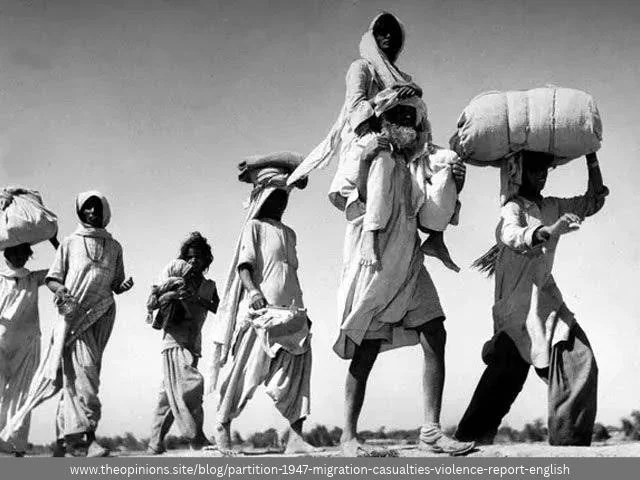
If the Partition of India brought independence to Pakistan and India on one hand, on the other it ranks among the bloodiest, most shameful and most hate-filled events in world history. People unfamiliar with this event reduce it to a few lines drawn on a map that gave birth to two countries, while those who understand it still struggle with a single question: should it be called independence, or the single bloodiest and most shameful tragedy in the subcontinent's history?
This was a tragedy that left roughly 14 million people homeless, killed roughly 3 million, and produced events so horrifying that women's breasts were cut off, they were paraded naked through the streets, abducted and forced to convert their religion. Train drivers were sometimes left alive for one single reason: so they could deliver a train full of corpses to the people waiting for their loved ones.
According to official records, around 83,000 women and children went missing during this tragedy, of whom only about 30,000 were ever found; the rest have never been traced to this day.
This report sets out to answer four basic questions:
- How many people were displaced during the Partition of India?
- Where did they move from, and to?
- How many people lost their lives?
- What happened to women during this period?
It also includes a few accounts that people witnessed with their own eyes at the time of Partition. Every significant fact in this report carries a verifiable source, so readers can check the information themselves. Estimates differ across researchers and historical sources, so where necessary, a range of figures is given rather than a single final number.
1. The number of people displaced
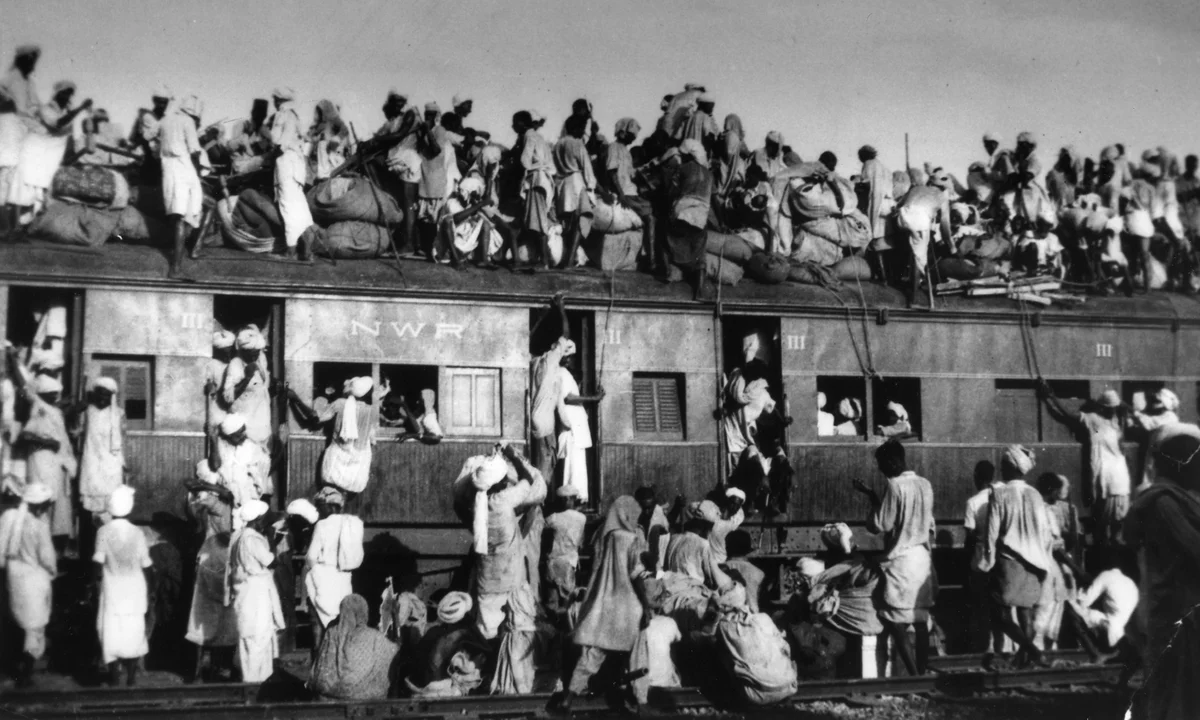
Researchers and historians disagree on the total number of people displaced during the Partition of India. Different historical studies place the figure anywhere between 14 million and 22 million. This includes everyone who was forced to leave their ancestral land and generations-old homes and migrate to the other side as a result of Partition.
However, the more widely accepted and credible estimate falls between 14 and 15 million. This estimate is supported by the research of Guneeta Singh Bhalla and C. Ryan Perkins, among other historical sources. [1] [2] [5]
2. Where did people move from and to?
According to the United Nations' report, The Population of Asia and the Far East, 1950 to 1980, the approximate movement of people between different regions during the Partition of India was as follows:
| Migration route | Estimated number |
|---|---|
| India to West Pakistan | 6.5 million |
| India to East Pakistan | 2.5 million |
| West Pakistan to India | 4.7 million |
| East Pakistan to India | 0.5 to 0.7 million |
| India to Pakistan (total) | 9 to 10 million |
| Pakistan to India (total) | 5 to 6 million |
Source: United Nations report. [7]
3. How many people lost their lives (1947 Partition)
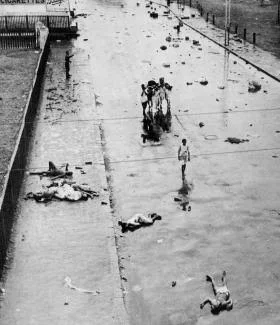
The Partition of India was not just a division of borders; it was a loss of human life whose effects were felt for generations. According to various credible sources, roughly 2 million people were killed as a result of violence, killings, suicides and other acts of brutality. Children, the elderly, men and women were all among the dead. Even people with no connection to the underlying political and religious conflict were caught in the bloodshed.
Guneeta Singh Bhalla has put the death toll as high as 3 million. Her estimate also includes people who died from conditions, diseases and other after-effects that followed Partition. [2] [3]
These figures are not just numbers. Behind every number was a life, a family, and a story that perhaps never even made it into the historical record. Thousands of children were orphaned, and countless families were separated from their loved ones forever.
3.1 How many died on each side?
There is no single credible, complete official record that clearly establishes how many people died on the Indian side versus the Pakistani side. Independent historical sources generally agree that the scale of violence suffered was roughly equal on both sides.
In other words, no single religion or nation alone bore this human tragedy. On both sides, mothers lost their children, children lost their parents, and families lost their loved ones. The line of Partition did not just separate two countries; it changed millions of lives forever.
4. Train massacres: when a journey became the last journey
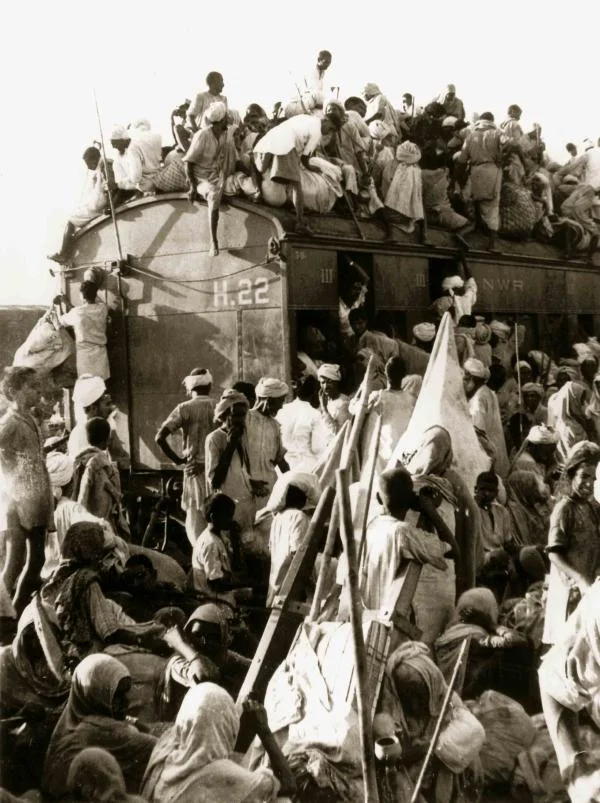
Among the most painful and soul-shaking events of the Partition of India are the attacks on refugee trains. The very trains on which people traveled to save their lives often became, instead, their final journey.
Armed and enraged mobs on both sides targeted innocent passengers who were migrating. Historical accounts describe incidents in which entire trainloads of passengers were killed, with only the driver left alive, so he could deliver the train full of corpses to its destination. Imagine what it must have been like for those waiting at the destination for their loved ones, when the train finally arrived: instead of the return of life, they received a message of death.
These attacks were not simply a loss of human life; they were part of a cycle of fear, revenge and hatred that engulfed society on both sides. Each new attack fanned the flames of revenge further, and innocent people paid the price with their lives.
4.1 Amritsar train massacre (22 September 1947)
An armed mob, which included Sikh jathas, attacked a refugee train near Amritsar railway station. Around 3,000 Muslim passengers were killed and more than 1,000 wounded in this incident. Earlier, in early September, another train had been attacked near Khalsa College, killing around 1,000 people.
These were people who had left behind their homes, their land and their old lives in search of a safer future. But their journey was ended before they could reach their destination. [8]
4.2 Gujrat train massacre (12 January 1948)
A refugee train departing from Bannu (in present-day Khyber Pakhtunkhwa) was diverted toward Gujrat railway station in Pakistan. There, the engine driver fled with the locomotive, and an armed Pashtun mob attacked the train. Between 1,300 and 1,600 Hindu and Sikh refugees were killed in this incident. [9]
4.3 Kamoke train massacre
Near Kamoke, about 25 miles from Lahore, a large mob attacked more than 3,000 Hindu and Sikh refugees traveling in livestock wagons of a goods train. According to official records, more than 400 people were killed in this incident, and hundreds of women were abducted. Unofficial estimates put the death toll considerably higher. [10]
4.4 The intensity of hatred and the government response
According to a report in The Guardian, in some attacks the assailants killed every passenger on the train except the driver, leaving him alive specifically so he could deliver the train full of corpses to the victims' relatives. Such incidents deepened the fear and hatred that already existed, and fed a dangerous cycle of revenge. [11]
Conditions had deteriorated to the point that, by late September 1947, both governments were forced to temporarily suspend the movement of refugee trains in order to improve security arrangements. [8]
5. Eyewitness accounts
History books often describe events through statistics and dates, but the true agony of these events is best understood through the first-hand accounts of the people who saw and lived through them. The testimonies of Partition survivors paint a picture of the fear, helplessness, displacement and human suffering of that era that cannot be captured in a few sentences.
Patricia (five years old at the time)
Patricia's family was migrating from India to Pakistan. Near the border, their train was stopped and fired upon from outside. Her father wrapped the children in bedding rolls to hide them so they would not be hit by bullets. Everyone traveling on the roof of the train was killed. Patricia's most haunting memory of the event is the sound of children crying, a sound that remains with her to this day. [12]
Captain M.S. Kohli (the well-known mountaineer)
Captain M.S. Kohli's family was migrating from Pakistan to India when their goods train was attacked by an armed mob. The situation had become extremely dangerous, but at the critical moment, Brigadier Ayub Khan, a friend of his father's who later became President of Pakistan, arrived with his military unit. His intervention saved the lives of Captain Kohli's family. [13]
Mr. Chopra
Mr. Chopra's family suddenly left their home for the railway station. During the journey, their train came under fire from both sides, and a bullet struck Mr. Chopra in the foot. His grandmother bound the wound with cloth to stop the bleeding. In the chaos, a Muslim fellow passenger claimed the family as his own and, in doing so, saved their lives. During the journey, they saw bodies scattered along the railway tracks.
This account also reveals another truth about that era: even when hatred and violence were at their peak, some people never forgot their humanity. A Muslim passenger claiming a family of a different religion as his own, to save them, is an example of how human compassion survived even in that violent time. [14]
5.1 Case study: Ali Shan (village Jarahan, district Ludhiana)
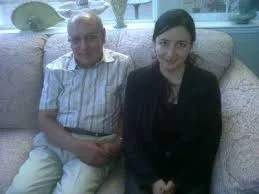
Ali Shan's story is one of the most painful accounts of the Partition of India, one that shows that Partition did not just take away homes and land; for some children, it took away their parents, siblings and entire childhood.
In 1947, Ali Shan was about six to eight years old. He lived with his family in the village of Jarahan in district Ludhiana. [15] [16] [2]
1. The attack on the village
One day an armed mob attacked their village. Ali Shan watched, in front of his own eyes, as his family and most of the people in his village were killed. He was so young at the time that he may not have fully understood what was happening, but watching his loved ones die became a part of him for the rest of his life.
2. Saved from death
During the attack, an armed man fired several shots at Ali Shan, but by chance, none of the bullets hit him. A man in the mob caught hold of him. But instead of killing him, he decided to take the child with him. And so a small boy, who moments earlier had watched his entire family die, escaped death.
3. Raised by a Sikh family
The man walked Ali Shan for two days and two nights to another village and handed him over to a Sikh family. That family raised him as their own son. Ali Shan lived in that household for about six months. During this time, his religion was changed, and he was raised as a Sikh child.
4. Recovery and the Lahore refugee camp
After Partition, an agreement was reached between the two governments for the recovery of separated children and women. Through this process, someone reported that a Muslim child was living with a Sikh family.
Following this report, the Pakistani military took Ali Shan from there and brought him to a refugee camp in Lahore. He was now in a camp surrounded by many people, yet with no one of his own. He was a small child who had first lost his home, then his family, and now the next stage of his life was passing alone in a refugee camp.
5. Reunited with family
Ali Shan's maternal uncle lived in Kasur and had been searching for him across different refugee camps for days. He eventually found Ali Shan at the camp in Lahore. In this way, he was reunited with his surviving relatives and moved to Kasur, where he was raised the rest of the way.
6. Today: a living memory
Ali Shan later moved to the United States and settled permanently in the San Francisco Bay Area. He spent much of his life working through the trauma of his childhood and its effects. He shared his story with the 1947 Partition Archive, so that what he witnessed and endured could reach future generations. [15] [16] [2]
Ali Shan's story is not just the account of one person's life; it represents the thousands of children who lost their parents, their homes and their childhoods during the Partition of India. Some children were eventually reunited with their separated families, but the wounds inflicted on their childhoods may never have fully healed.
6. Honor killings and suicides
During the Partition of India, women did not only face displacement, violence and the destruction of their homes; they also faced a terrifying social pressure and inhuman set of attitudes in which other people began making decisions over their very life and death.
According to research by Urvashi Butalia, when armed mobs attacked different areas, some families' own men, including fathers, brothers and husbands, killed the women of their own households or poisoned them. Their belief was that this would save the women from falling into the hands of the "enemy" and becoming victims of violence. [17]
6.1 Thoa Khalsa (Rawalpindi): the 90 women who jumped into a well
The incident at Thoa Khalsa, Rawalpindi, is counted among the most painful events in the history of the Partition of India. Here, around 90 Hindu and Sikh women took their own lives amid armed attacks and the fear of falling into enemy hands. According to tradition, these women jumped into a well. [17]
6.2 Suicides among Muslim women in East Punjab
Such events were not confined to Rawalpindi or to Sikh and Hindu communities alone. Similar incidents occurred in various Muslim villages of East Punjab, where Muslim women, out of fear of armed attacks, violence and capture, took their lives by jumping into canals and wells. [17]
These events make clear that the cruelty of Partition was not confined to any single nation, religion or region. Women on both sides of the border paid an extraordinarily heavy price in this human tragedy.
7. Violence against women and abductions
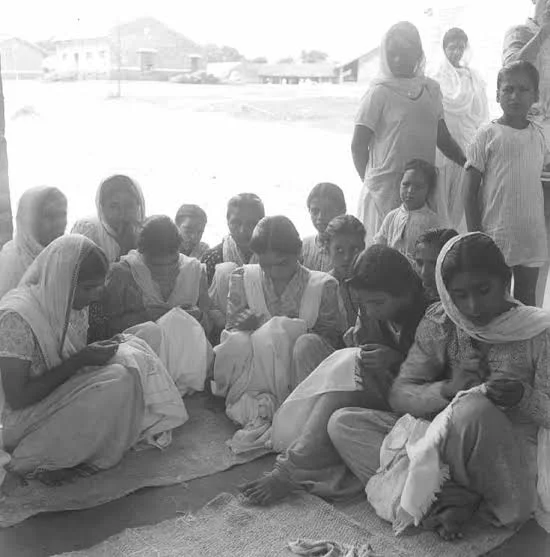
Violence against women during the Partition of India was the most painful and shameful aspect of this human tragedy. In this wave of violence rooted in religion and sect, women's bodies too became targets of hatred, revenge and enmity. They were abducted purely on the basis of their identity, subjected to physical violence, and had their dignity and freedom violated. In this way, women's bodies were turned into yet another battlefield in the hostility and revenge between two nations. [3]
Among those who suffered this violence were young girls, married women and even young children. Many women were separated from their homes, while many others were forcibly separated from their children and families.
7.1 The number of women abducted
According to various historical studies, roughly 75,000 to 100,000 women were forcibly abducted from both sides during the Partition of India. Some newer research estimates put this figure as high as 120,000. [3]
7.2 Official records: how many Muslim women, and how many Hindu and Sikh women, were abducted?
Official records in both countries list different figures for the number of women abducted. According to official records:
- In India: approximately 50,000 Muslim women were abducted.
- In Pakistan: approximately 33,000 Hindu and Sikh women were abducted.
These figures relate to the official recovery efforts and records maintained by the two countries at the time regarding women. [18]
7.3 Physical violence and desecration
Beyond abduction, women were also subjected to various forms of physical and sexual violence. In many areas, they were publicly humiliated, degraded in front of others, and had markings of a different religion forcibly placed on their bodies. In some cases, women's bodies were deliberately disfigured in an attempt to change or erase their religious identity. [3]
8. The recovery operation: the return of separated women
After the Partition of India, both countries faced another grave problem: the thousands of women who had been separated from their families as a result of violence and abduction. To address this issue, India and Pakistan passed the Abducted Persons (Recovery and Restoration) Act in 1949. Under this law, the police and military of both countries cooperated to search for abducted women and return them to their country of origin. [4]
This operation was an attempt to reunite these women, who had been forcibly separated from their homes during Partition, with their original families. However, the operation also brought to light several aspects that made the entire process more complicated and painful.
8.1 Recovery figures (1955 to 1957)
Between 1955 and 1957, the joint efforts of both countries recovered more than 30,000 women. According to official records:
- From India to Pakistan: approximately 20,728 Muslim women were recovered and sent to Pakistan.
- From Pakistan to India: approximately 9,032 Hindu and Sikh women were recovered and sent to India. [4]
These figures represent the scale of the operation through which thousands of women were sought to be returned to their original families. But behind each of these figures lay a separate, individual story. Some women, even after returning home, were never able to reclaim the life they had known before.
8.2 The recovery operation: when return itself became a new trauma
The most complicated and painful aspect of the recovery operation was that many women had, by then, begun building lives in their new homes. Some had given birth to children, and some had already formed new relationships and new homes with their new families. Yet under the official operation, they were separated from these new homes and children and sent back to their countries of origin.
For many women, this was effectively a second displacement: the first time, they had been forcibly removed from their original homes; the second time, they were being separated from the places where they had, over time, tried to rebuild their lives.
An even more painful aspect was that some women were refused acceptance by their original families. They were rejected in the name of family honor and social custom, considered impure or defiled. In this way, for some women, returning to their original country and family became not a safe destination, but the beginning of a new ordeal. [4]
The stated purpose of this operation was to return women to their families, but in the process, these women's own wishes and decisions were not always given central importance. This is a critical aspect for understanding the state of women's autonomy and rights during this period.
9. Key findings and facts
After reviewing the displacement, loss of life, violence and crimes against women during the Partition of India, a few core findings emerge:
- Displacement: the most widely agreed estimate across research sources for the number of people displaced is between 14 and 15 million, though some researchers have cited higher figures. [1] [2]
- Loss of life: estimates of the number of people killed during the Partition of India range between roughly 2 and 3 million. Different researchers' estimates vary. [2] [3]
- Violence on both sides: independent historical sources generally state that the scale of violence was roughly equal on both sides. However, there is no complete, credible official record that can offer a definitive comparison of casualties on each side.
- Train attacks and violence against women: attacks on refugee trains and violence against women are among the most painful and most thoroughly documented aspects of the Partition of India. [8] [9] [10] [3]
- Recovery operation: the joint operation between the two countries recovered more than 30,000 women. However, this operation also created new problems and human tragedies for many women, particularly those separated from their children and new homes. [4]
- Disagreement in the figures: most of the core statistics relating to the Partition of India carry differing estimates. For this reason, whenever presenting any figure, it is important to cite its source, its research background and, where appropriate, a range rather than a single number.
The history of the Partition of India is not simply the story of the creation of two new countries, the drawing of borders and political decisions. It is also the story of the migration of tens of millions of people, the destruction of countless homes, immeasurable loss of human life, and families who were separated from one another in a single day. To understand this history, it is necessary to remember, alongside its political and religious dimensions, the stories of the ordinary people who paid the heaviest price for this division.
Author's Note

I had heard a great deal about the Partition of India from my teachers, my father, and other people familiar with its history. However, I had never fully realised just how painful and devastating this tragedy had been. When I began researching the subject in earnest, studying historical documents, academic research, and the writings of various authors, the true scale of the human suffering began to emerge. I was deeply saddened by what I discovered. The accounts of atrocities committed against women and children, families torn apart, and people who lost their loved ones forever left me so distressed that I find it difficult to put my feelings into words.
Throughout the preparation of this report, I have tried to present every detail with care and impartiality. Wherever possible, I have relied on credible sources that readers can independently verify. Where historians and researchers disagree on figures, I have avoided presenting a single number as definitive and instead provided the available estimates as ranges. These are not merely statistics. Behind every figure are human lives, shattered homes, separated families, and stories whose consequences were felt for generations.
The purpose of this report is not to debate whether the Partition of India was the right or wrong political decision. That is a separate historical and political debate. For me, the more important question is why millions of people were left so vulnerable and unprotected as the subcontinent was being divided. The governments of India, Pakistan, and the United Kingdom should formally acknowledge that their failure to protect human lives and fundamental rights during Partition resulted in the deaths of millions, the sexual abuse and persecution of thousands of women, and the disappearance or separation of thousands of women and children from their families.
In my view, these governments should issue a formal apology to the affected populations, particularly to the families who lost their loved ones in this tragedy. Official recognition cannot bring back the past or reunite those who were separated, but it can acknowledge the suffering and sacrifices of the victims, preserve their memory, and demonstrate to future generations that their pain has not been forgotten.
Faizan AK Azaad
10. Sources
- Wikipedia, Partition of India
- NEH, The Story of the 1947 Partition, Told by the People Who Were There
- Wikipedia, Violence against women during the Partition of India
- Urvashi Butalia, The Other Side of Silence (NYT excerpt)
- Stanford Libraries, 1947 Partition of India and Pakistan
- A Tale of Two Cities: The Aftermath of Partition for Lahore and Amritsar 1947 to 1957, Modern Asian Studies, Cambridge
- United Nations, The Population of Asia and the Far East, 1950 to 1980 (1959)
- Wikipedia, 1947 Amritsar train massacre
- Wikipedia, 1948 Gujrat train massacre
- Wikipedia, 1947 Kamoke train massacre
- The Guardian, Wounds have never healed: living through the terror of Partition (2017)
- The Guardian, Everything changed: readers' stories of India's Partition (2017)
- Partition Museum, The Railways and Partition, Google Arts & Culture
- Stanford 1947 Partition Archive, Interviews
- Stanford 1947 Partition Archive, Ali Shan
- Google Arts & Culture, Ali Shan
- JSTOR Daily, Women, Partition and Violence
- LUMS Partition Archive, Partition Abductions
Note: AI was used to translate this report into English. However, the Urdu version is the original text, written entirely by the author in his own words.