
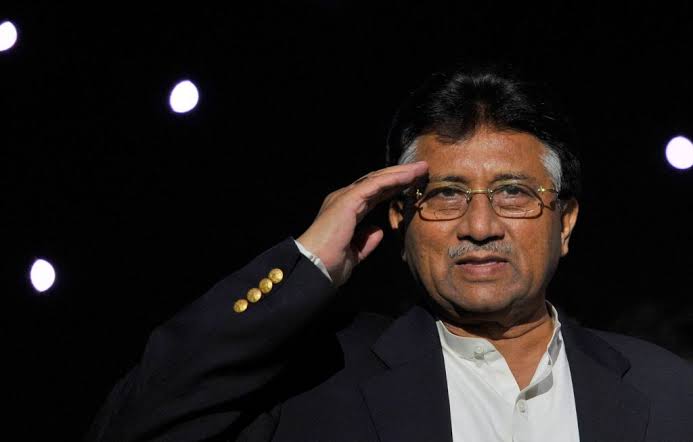
General (retired) Pervez Musharraf is one of the few figures in Pakistan's military and political history whose decisions reshaped the country's internal structure, economy, media landscape, and foreign policy at the start of the 21st century. He served as the Pakistan Army's seventh Commander-in-Chief/Chief of Army Staff, the country's Chief Executive, and its tenth President.
Family background, early life, and education (1943–1961)
Birth and family: Pervez Musharraf was born on August 11, 1943, in the historic "Nehar Wali Haveli" in the Daryaganj area (Kucha Sadullah Khan) of Old Delhi, British India, into an educated Syed family. His father, Syed Musharrafuddin, was a graduate of Aligarh Muslim University and served in the Foreign Service, while his mother, Begum Zarin, was educated in Lucknow and later worked with a UN subsidiary agency (the ILO). Musharraf was the second of three brothers (Javed Musharraf, Pervez Musharraf, and Naveed Musharraf).
Migration and time in Turkey: In August 1947, at the time of Partition, his family migrated to Karachi. In 1949, his father was posted to the Pakistani embassy in Ankara, Turkey's capital. Musharraf spent seven formative years of his childhood in Turkey, from 1949 to 1956. There, he learned to speak Turkish fluently and was deeply influenced by the ideas of Mustafa Kemal Atatürk, the founder of modern Turkey, an influence that later surfaced in his own policies.
School and college education: After returning to Pakistan in 1956, he passed his matriculation from the well-known St. Patrick's High School in Karachi. He then enrolled at Lahore's historic Forman Christian College (FC College), where mathematics and economics were his favorite subjects.
Marriage and children: He married Sehba Farid on December 28, 1968. They have two children, a son, Bilal Musharraf, and a daughter, Ayla Musharraf.
Early military career and wars (1961–1998)
Pakistan Military Academy, Kakul: In 1961, he joined the 29th PMA Long Course at the Pakistan Military Academy (PMA) in Kakul. After passing out in April 1964, he was commissioned as a Second Lieutenant in an Artillery regiment, with his first posting at Kharian Cantonment.
The 1965 Indo-Pakistani War: Just a year after his commission, the September 1965 war broke out. He served on the front lines in the Khem Karan and Lahore sectors with a field artillery regiment. He was awarded a commendation for bravery under heavy shelling.
SSG commando service and the 1971 war: In 1966, he joined the Pakistan Army's elite commando unit, the Special Services Group (SSG), remaining with it until 1972. During the 1971 war, he commanded a company of the SSG commando battalion, deployed on the Punjab front.
The Siachen front (1987): In September 1987, as a Brigadier, he took command of a newly raised SSG brigade on the extremely difficult Siachen Glacier front (the Bilafond La pass).
Senior military education and promotions: He completed courses at the Command and Staff College, Quetta, and the National Defence College (NDC) in Rawalpindi, and also received advanced military training at the UK's prestigious Royal College of Defence Studies (RCDS).
1991: He was promoted to Major General and, on January 15, 1991, appointed General Officer Commanding (GOC) of the 40th Infantry Division in Okara.
1993: He was posted to the highly important position of Director General Military Operations (DGMO), and also served as the Prime Minister's briefing officer during Benazir Bhutto's second term.
1995: He was promoted to Lieutenant General and posted as Corps Commander of the country's key strike formation, Mangla Corps (I Corps).
Appointment as Army Chief and the Kargil conflict (1998–1999)
Appointment as Army Chief: In October 1998, then-Army Chief General Jehangir Karamat resigned after Prime Minister Nawaz Sharif objected to his remarks about establishing a National Security Council. On October 7, 1998, Prime Minister Nawaz Sharif bypassed more senior generals (Lieutenant General Ali Quli Khan and Lieutenant General Khalid Nawaz) and appointed General Pervez Musharraf as a four-star general and Chief of Army Staff. In April 1999, he was also given additional charge as Chairman of the Joint Chiefs of Staff Committee.
The Kargil War (May–July 1999): A few months after Indian Prime Minister Atal Bihari Vajpayee's February 1999 visit to Lahore and the resulting "Lahore Declaration," armed conflict broke out in May 1999 in the Kargil and Dras mountain ranges. General Musharraf was the central planner of this operation, aimed at cutting the Indian supply line (NH-1D) connecting to Siachen. However, the move brought intense international diplomatic pressure on Pakistan. Following a meeting between US President Bill Clinton and Nawaz Sharif in Washington on July 4, 1999, the withdrawal of Pakistani troops was announced. The episode created deep mistrust and a rift between the civilian government and the military leadership.
The October 12, 1999 takeover and martial law
Following the Kargil conflict, relations between Prime Minister Nawaz Sharif and General Musharraf had become extremely tense.
The plane incident and the coup: In October 1999, General Musharraf traveled to Colombo to attend the Sri Lankan Army's Golden Jubilee celebrations. On the evening of October 12, as he was flying back to Karachi on a PIA flight (PK-805), Prime Minister Nawaz Sharif dismissed him and announced the appointment of DG ISI Lieutenant General Ziauddin Butt as the new Army Chief, issuing orders that Musharraf's plane not be allowed to land at Karachi airport.
The military's response: Corps commanders in Rawalpindi and Karachi refused to accept the Prime Minister's order. The military took control of PTV, the Prime Minister's House, and Karachi airport, after which Musharraf's plane landed safely in Karachi (with reportedly only a few minutes of fuel remaining).
Becoming Chief Executive: On October 14, 1999, General Musharraf declared a state of emergency, suspended the 1973 Constitution, issued a Provisional Constitutional Order (PCO), and, rather than taking the traditional title of "Chief Martial Law Administrator," declared himself the country's "Chief Executive." In May 2000, the Supreme Court, in the Zafar Ali Shah case, granted legal cover to his action under the doctrine of necessity for a period of three years, and also gave him the power to amend the Constitution. In December 2000, through Saudi mediation, Nawaz Sharif and his family were sent into a ten-year exile in Jeddah.
Presidency, referendum, and constitutional structure (2001–2004)
Assuming the presidency: Ahead of a visit to India (the Agra Summit), General Musharraf removed then-President Muhammad Rafiq Tarar from office and took the oath as President of Pakistan on June 20, 2001.
The presidential referendum (2002): To extend his hold on power, he held a nationwide presidential referendum on April 30, 2002. According to official figures, more than 97% of voters supported his five-year presidency, though opposition parties called it heavily rigged.
The Legal Framework Order (LFO) and the 2002 elections: In August 2002, he issued the Legal Framework Order, making numerous constitutional amendments, including restoring the President's power to dissolve the National Assembly (Article 58-2B) and establishing the National Security Council. General elections were held in October 2002, in which the pro-Musharraf Pakistan Muslim League (Q) emerged as the largest party. During his tenure, Mir Zafarullah Khan Jamali, Chaudhry Shujaat Hussain, and Shaukat Aziz served as Prime Minister in succession.
The Seventeenth Amendment (2003): In December 2003, the Seventeenth Constitutional Amendment was passed under an agreement with the religious parties' alliance, the Muttahida Majlis-e-Amal (MMA), in exchange for which Musharraf promised to give up his military uniform by December 2004. He later failed to keep that promise and retained both positions.
9/11 and the War on Terror
The September 11, 2001 al-Qaeda attacks on the World Trade Center and the Pentagon in the United States reshaped global politics, and the direction of Musharraf's government along with it.
The American ultimatum and a foreign policy U-turn: US Secretary of State Colin Powell and Deputy Secretary of State Richard Armitage presented Pakistan with seven demands. Musharraf claimed in his memoir that the US had threatened to bomb Pakistan "back to the Stone Age" if it did not cooperate. Adopting the slogan "Pakistan First," Musharraf decided to withdraw support for the Taliban government in Afghanistan and become a frontline ally in America's "War on Terror."
Cooperation and financial assistance: Pakistan provided US and allied forces with air corridors, logistical support, intelligence sharing, and access to several airbases, including Shamsi airbase. In return, nuclear-related sanctions on Pakistan were lifted, billions of dollars in foreign debt were rescheduled or forgiven, and in 2004 the US designated Pakistan a "Major Non-NATO Ally."
Domestic fallout and suicide bombings: This policy triggered strong backlash among the country's religious and political circles. For the first time, the Pakistan Army was deployed in the tribal areas (North and South Waziristan) against al-Qaeda and foreign fighters, and operations began. This set off a wave of terrorism and suicide bombings inside Pakistan. In December 2003, near Jhanda Chichi Bridge in Rawalpindi, General Musharraf's own convoy survived two terrifying suicide attacks within a fourteen-day span.
Kashmir, the Agra Summit, and the four-point formula
Despite being the architect of the Kargil conflict, Musharraf showed unconventional flexibility toward peace talks with India after assuming the presidency.
The Agra Summit (July 2001): He visited India at the invitation of Indian Prime Minister Atal Bihari Vajpayee. Talks at Agra ended without result, but his outspoken conversation with Indian media editors during the visit earned him considerable international attention.
Ceasefire on the Line of Control and composite dialogue: A ceasefire agreement on the Line of Control was reached in November 2003. In January 2004, on the sidelines of the SAARC summit in Islamabad, a meeting between Musharraf and Vajpayee launched the India-Pakistan "Composite Dialogue," which was later carried forward with Indian Prime Minister Manmohan Singh as well.
The four-point formula on Kashmir: Musharraf proposed an informal "four-point formula" for resolving the Kashmir dispute, whose key points were:
- Making the Line of Control irrelevant through free movement (soft borders), without changing Kashmir's boundaries
- Gradual demilitarization of both parts of Jammu and Kashmir
- Granting self-governance to Kashmiris on both sides
- Establishing a joint supervision mechanism involving India, Pakistan, and Kashmiri representatives
The Dr. A.Q. Khan affair (2004): In January 2004, amid international pressure over nuclear proliferation, Dr. Abdul Qadeer Khan was made to give a televised confessional statement, after which Musharraf granted him a presidential pardon and placed him under house arrest, a decision that drew sharp domestic criticism of Musharraf.
Economic, educational, local government, and social reforms
The first six years of Musharraf's rule (2000–2006) are known for several structural changes in Pakistan:
| Area | Notable measures and reforms |
|---|---|
| Economy and investment | Under Shaukat Aziz's economic team, banking privatization, growth of the telecom sector, and record foreign investment took place. Between 2004 and 2006, Pakistan's GDP growth rate reached 7–8%, and the Karachi Stock Exchange hit historic highs. The first phase of Gwadar Deep Sea Port was completed with Chinese cooperation. |
| Local government system (Devolution Plan 2001) | Bureaucratic powers were reduced, with financial and administrative authority devolved to elected nazims at the district, tehsil, and union council levels. |
| Independent electronic media (PEMRA) | PEMRA was established in 2002, and for the first time in Pakistan's history, dozens of private TV channels and FM radio stations were licensed. |
| Higher education (HEC) | In 2002, the University Grants Commission was dissolved and replaced by the Higher Education Commission (HEC), headed by Dr. Atta-ur-Rahman. The education budget was increased many times over, dozens of new universities were established, and thousands of students received PhD scholarships abroad. |
| Women's rights and "enlightened moderation" | He introduced the concept of "Enlightened Moderation." He increased the quota of reserved seats for women in the national and provincial assemblies and local bodies, opened the armed forces to women, appointed Dr. Shamshad Akhtar as the State Bank's first female governor, and had the Women's Protection Bill passed in 2006. |
Severe crises, conflicts, and the end of his rule (2006–2008)
After 2006, a string of harsh decisions by Musharraf severely damaged his popularity and paved the way for the end of his rule:
The killing of Nawab Akbar Bugti (August 2006): Tensions rose over the dispute surrounding gas royalties and provincial rights in Balochistan. On August 26, 2006, veteran Baloch leader and former governor and chief minister Nawab Akbar Khan Bugti was killed during a military operation in the mountains of Kohlu, sparking a fresh wave of separatism and insurgency in Balochistan.
The judicial crisis and the lawyers' movement (March 2007): On March 9, 2007, General Musharraf summoned Chief Justice of Pakistan Iftikhar Muhammad Chaudhry to Army House and demanded his resignation; when he refused, Musharraf suspended him and referred him to the Supreme Judicial Council. A nationwide "lawyers' movement" erupted against this move. On May 12, 2007, ethnic and political violence broke out during the Chief Justice's visit to Karachi, killing more than 40 people. In July 2007, a full bench of the Supreme Court reinstated Iftikhar Chaudhry.
The Lal Masjid operation (July 2007): Months of tension between the administration of Lal Masjid (Red Mosque) and Jamia Hafsa, led by Maulana Abdul Aziz and Abdul Rashid Ghazi, and the government, over the enforcement of Sharia and a parallel judicial system, turned into armed conflict in July 2007. "Operation Silence," which ran from July 3 to 11, left more than a hundred people dead, including Abdul Rashid Ghazi. In response to this episode, the Tehrik-i-Taliban Pakistan (TTP) was formed in December 2007, unleashing a wave of suicide bombings across the country.
The NRO and the November 3, 2007 emergency: Through US and UK mediation, Musharraf issued the National Reconciliation Ordinance (NRO) on October 5, 2007, as part of a political reconciliation with Benazir Bhutto, under which old corruption cases against politicians were dropped. Separately, as a Supreme Court ruling against his re-election as President in uniform appeared likely, he declared a second state of emergency on November 3, 2007, suspending the Constitution, issuing a new PCO, suspending and placing roughly 60 superior court judges under house arrest, and shutting down private news channels.
Giving up the uniform and the assassination of Benazir Bhutto: Under intense domestic and international pressure, he handed over command of the Pakistan Army to General Ashfaq Pervez Kayani on November 28, 2007, and took oath as a civilian President the next day. However, the assassination of former Prime Minister Benazir Bhutto at Liaquat Bagh in Rawalpindi on December 27, 2007, politically crippled Musharraf's government.
The 2008 elections and resignation: In the general elections of February 18, 2008, Musharraf's allied PML-Q suffered a crushing defeat. The Pakistan Peoples Party and PML-N formed a coalition government. In August 2008, when the ruling coalition finalized its decision to move an impeachment motion against him in parliament, General Pervez Musharraf resigned from the presidency on August 18, 2008, in a farewell address to the nation.
Exile, court cases, books, and death (2008–2024)
Self-imposed exile and a political party: After resigning, he relocated to London and Dubai. On October 1, 2010, he founded his political party, the All Pakistan Muslim League (APML), in London.
Return and detention (2013): On March 24, 2013, he ended his self-imposed exile and returned to Pakistan to contest the general elections, but the courts rejected his nomination papers and declared him disqualified for life. He was placed under house arrest at his farmhouse in Chak Shahzad, Islamabad.
The high treason case and death sentence: Besides the Benazir Bhutto murder case, the Akbar Bugti murder case, the judges' detention case, and the Lal Masjid case, Prime Minister Nawaz Sharif's government filed a case against him in December 2013 under Article 6 (high treason) of the Constitution over the imposition of the November 3, 2007 emergency. After his name was removed from the Exit Control List by a court in March 2016, he left for Dubai for medical treatment and never returned.
On December 17, 2019, a three-member special court headed by Justice Waqar Ahmad Seth sentenced him to death for violating the Constitution, the first time in Pakistan's history that a former military ruler had received such a sentence.
In January 2020, the Lahore High Court declared the special court's formation unconstitutional and struck down the sentence. However, after Musharraf's death, on January 10, 2024, a four-member bench of the Supreme Court of Pakistan, headed by Chief Justice Qazi Faez Isa, set aside the Lahore High Court's ruling and posthumously restored and upheld the death sentence handed down by the special court.
Writing: His memoir, "In the Line of Fire: A Memoir," was published in September 2006; its Urdu translation was published under the title "Sab Se Pehle Pakistan" ("Pakistan First").
Illness and death: In his final years, Pervez Musharraf suffered from amyloidosis, a rare and incurable disease in which abnormal proteins build up in the body's organs, causing them to fail. After a prolonged illness, he died on February 5, 2023, at age 79, at the American Hospital in Dubai. His body was flown to Karachi, where he was buried with full military honors at the Malir Cantonment military graveyard on February 7, 2023.
Key milestones in his life and career
| Milestone | Date | Detail |
|---|---|---|
| Birth | August 11, 1943 | Born to Syed Musharrafuddin at the Nehar Wali Haveli in Old Delhi, British India. |
| Commission in the Pakistan Army | April 1964 | Completed training at the Pakistan Military Academy, Kakul, and was commissioned as a Second Lieutenant in an Artillery regiment. |
| Appointment as Army Chief | October 7, 1998 | Prime Minister Nawaz Sharif appointed him a four-star general and Chief of Army Staff after General Jehangir Karamat's resignation. |
| Kargil conflict and military coup | May–October 1999 | The Kargil War was fought from May to July; on October 12, 1999, he overthrew the Nawaz Sharif government and became Chief Executive. |
| Presidential oath and 9/11 | June–September 2001 | Took oath as President of Pakistan on June 20, 2001; became an ally in America's War on Terror after September 2001. |
| Lal Masjid operation and emergency | July–November 2007 | A judicial crisis in March, the Lal Masjid operation in July, and an emergency declared on November 3, 2007, with judges placed under house arrest; he gave up command of the army on November 28. |
| Resignation from the presidency | August 18, 2008 | Resigned under pressure from an impeachment motion by the ruling coalition, ending his nine years in power. |
| Treason case verdict and death | 2019–2023 | A special court sentenced him to death under Article 6 in December 2019; he died in Dubai on February 5, 2023, at age 79, and was buried in Karachi. |